Home / Care / Dry, porous fiber and breakage
Care
Dry, porous fiber and breakage
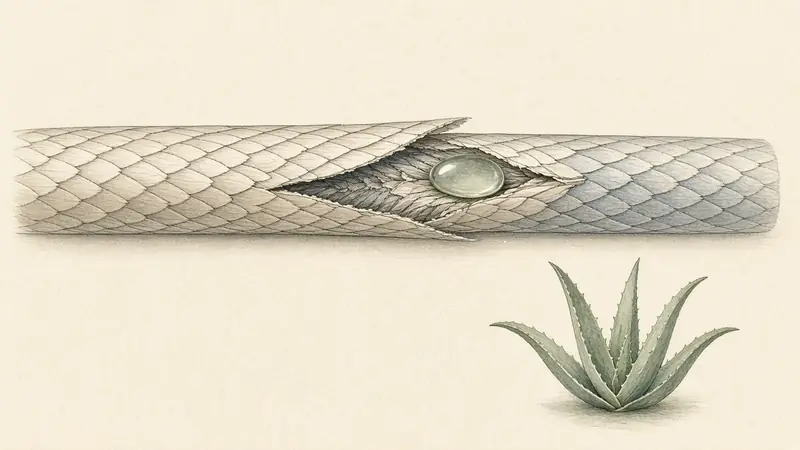
The picture this page is for
Dry, porous hair soaks up water and product quickly and often loses them quickly. The lengths look rough, they tangle, they snap, and they can make a ponytail look thinner because many hairs no longer reach it. The roots may be a different story (a scalp can be oily while the ends are desperate), and a routine that treats the head as one texture will usually fail one of the two. This is a fiber problem first. If you also have a widening part or a patterned crown, you have two pictures, and you should read both, not replace one with the other.
Porosity, without a parlour myth
Porosity is about how readily a fiber takes in and lets go of water and of the things dissolved or suspended in it. Raised or weathered cuticles (from bleach, colour, heat, or simple age of the ends) make a hair more porous. Home tests, such as floating a strand in a glass of water, are widely repeated and not a precise laboratory measure. They can be roughly suggestive. They should not be used as a personality type, and they should not be used to sell you a dozen steps that a gentler handling would have made unnecessary.
| What often helps the fiber | What often makes it worse |
|---|---|
| Conditioner on the lengths, especially when the hair is wet and more vulnerable | Brushing soaked hair hard, or rubbing it with a rough towel |
| Fewer chemical and heat insults, and heat protection when you do use heat | Bleaching on a schedule that the ends have not recovered from |
| A protein-and-moisture routine that is adjusted to how the hair actually feels | A rigid ‘protein on Monday, moisture on Tuesday’ calendar copied from a stranger |
| A diet and, if relevant, essential-fatty-acid intake that a clinician is happy with | Pouring oil on a part that is actually a patterned thinning, and calling it treatment |
Hair is weaker when it is wet, which is why the handling page belongs next to this one. A snapped hair will not be un-snapped by a conditioner. The goal is to stop the next inch from going the same way, and to keep the lengths that remain in better company.
When dryness is not the only story
A painfully dry, scaly, or inflamed scalp is not a kitchen-oil problem. Sudden breakage with a sore scalp, or a patterned change that you have been blaming on porosity, should be examined. A dermatologist, or a trichologist at trichology.com, can look at both the fiber and the follicle.
Ends and roots are allowed to disagree
A common unhappiness is an oily part and dry ends. The usual mistake is to treat the whole head with the end-product, so the roots collapse, or with the root-product, so the ends snap. Wash the scalp, condition the lengths, and, if you use an oil, put it on the ends of dry or damp hair rather than on the part. If the part is also widening in comparable photographs, that is not a porosity fact; add the atlas pages, and do not pour more oil on a patterned view in the hope that it will fill in. The fiber and the follicle can be two jobs in the same week, and they need two kinds of attention.
Roots, lengths or fiber?
Four one-tap questions to sort a fiber issue from a root issue. Nothing is stored.
A reading of a picture, not a diagnosis. Your answers stay on this page and are never stored.
What people use for this
Dry, porous lengths respond to gentler washing on the outside and good nutrition on the inside. These are the two options discussed on this page.
- EFA COMPLETE: a dietary supplement of essential fatty acids.
- Peptide Shampoo and Conditioner Pack: a paired wash and conditioner.
Not sure which fits? The short quiz on this page suggests one first step from your answers.
Questions people actually ask
Should I do a protein treatment?
Some weathered hair feels better after a protein-containing conditioner; some becomes stiff and then snaps if protein is overused. There is no weekly rule this site will invent. Judge the hair in your hands, and stop a treatment that makes it feel like straw.
Does an omega supplement fix porosity?
No supplement closes a cuticle that bleach has lifted. Essential fatty acids are sometimes used as a nutritional support for hair and skin quality; they are not a topical seal and not a reason to keep bleaching on the same schedule.