Home / Care / Washing, friction and heat
Care
Washing, friction and heat
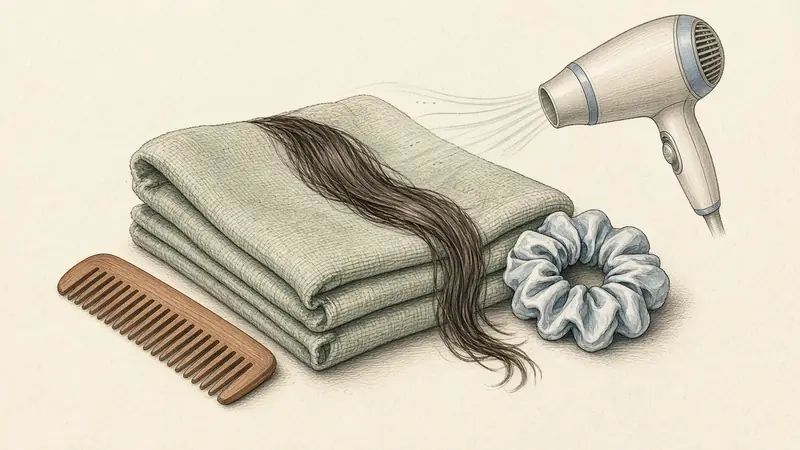
Hair is weaker when it is wet
A wet hair fiber stretches more easily and breaks more easily than a dry one. This is a materials fact, recorded in standard hair-science texts, and it is the most useful sentence on this page. Most everyday breakage is earned in the minutes after a wash: a rough towel, a tight comb through soaking hair, a twist, a tight clip on wet lengths, or a blast of heat before the hair has any business being asked to hold a shape. If your brush is full of blunt short pieces, and the roots look reasonably familiar, start here before you start a pattern product.
A calmer wash
| Moment | A gentler version | A costlier version |
|---|---|---|
| Wetting and washing | Let the hair saturate, use enough shampoo to clean the scalp, and save the scrubbing for the scalp rather than the lengths. | Raking a concentrated shampoo through dry, tangled hair, or stacking several harsh washes because the first one ‘did not foam.’ |
| Drying | A soft towel or a cotton T-shirt, pressed, not rubbed; detangle from the ends up, with a conditioner if you need one, before the hair is bone dry and knotted. | Terrycloth wringing, and starting a brush at the roots of soaking hair. |
| Heat | A lower setting, a longer distance, and a product that is actually a heat protectant if you blow-dry or use irons. | A daily high-heat pass on still-wet hair, especially on already porous ends. |
| Overnight and exercise | A loose style that does not saw at the hairline; a silk or satin pillowcase is a comfort for some people, not a miracle. | A tight wet bun, or a cap that rubs the same margin every afternoon. |
Wash frequency remains personal, as the shampoo page already said. The handling inside each wash is less personal than people think. Wet strength is not a hair-type opinion. If you wear styles that pull at the edges, read the traction page as well; a gentle wash will not save a margin that is being pulled every day.
Heat and chemistry, without a lecture
Colour, bleach, and relaxers change the fiber in ways that make all of the above more expensive. You do not have to give them up on the strength of a website, and this site will not tell you to. You do have to stop pretending that a snapped mid-length is a follicle problem, and you do have to give the ends a longer rest than a social calendar sometimes wants. If a professional colourist is in the picture, take the breakage photographs to them as well as to a clinician.
When handling is not enough
If the hair is coming out with bulbs on the end in large numbers, if the scalp is sore, or if a part is widening in comparable dry photographs, handling will not be the whole plan. See a dermatologist or a trichologist at trichology.com, and keep the gentler wash anyway. It is one of the few changes that is almost never wasted.
What a calmer week actually looks like
It looks ordinary. You wash when the scalp needs it, you press the water out instead of wringing, you detangle from the ends with some slip, you keep heat lower or less often, and you do not sleep in a tight wet bun. You do not invent a ten-step routine that you will abandon on Thursday. If the brush is still full of blunt pieces after a few weeks of this, look again at the ends and at the roots; if the pieces have bulbs, you may be shedding whole hairs, and the atlas and an appointment are the next step. If the pieces are still blunt and mid-length, look at colour, at heat, and at a style that may be sawing the same place every day. The calmer week remains the baseline, even when a second problem is found.
Roots, lengths or fiber?
Four one-tap questions to sort a fiber issue from a root issue. Nothing is stored.
A reading of a picture, not a diagnosis. Your answers stay on this page and are never stored.
What people use for this
Most everyday breakage happens in the wash, the towel and the brush. A paired shampoo and conditioner used gently is the simplest change.
- HairStem Peptide Shampoo: a peptide shampoo from Advanced Trichology.
Not sure which fits? The short quiz on this page suggests one first step from your answers.
Questions people actually ask
Is a silk pillowcase required?
No. Some people find less friction at night with silk or satin. It is a comfort and a possible reduction in rubbing, not a treatment for a patterned change.
Should I stop brushing?
Hair that is not detangled often knots and then breaks anyway. A wide-tooth tool, starting from the ends, on hair that has some slip, is usually kinder than never touching it and then tearing through a mat.