Home / See / Thinning at the edges
Presentation
Thinning at the edges
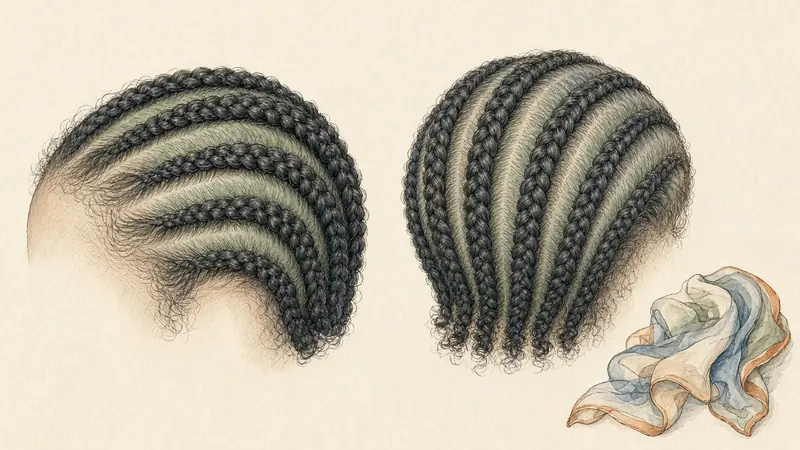
What this looks like
Thinning at the edges is a change that follows tension: the hairline around the temples and nape, a hard part, the margin of a tight bun, braid, ponytail, weave, or extension. The short hairs may be broken, or the hair may have become finer and sparser along that margin, or both. People often notice it when they change a style and the hairline no longer fills in the way it did, or when a hairdresser refuses to pull as tightly as before.
This presentation deserves more urgency than a slowly widening part in an otherwise comfortable scalp, because prolonged traction can become a permanent thinning. A style break is not always enough if the tension has already been a habit for years, but reducing the tension is still the first practical step, and it does not require a purchase.
What it can be confused with
| Lookalike | How it overlaps | A useful distinction |
|---|---|---|
| Temple recession of a patterned kind | Both open the front corners. | Traction follows the pulled hair and the style history. Patterned recession can occur without that history, and it may also involve the crown. They can coexist. |
| A changing hairline of another cause | The edge is the stage. | A band-like, even recession with eyebrow loss, or an inflamed edge, may be a different disease and should be examined. |
| Breakage at the margin | Short hairs along the edge. | Broken hairs from tension may grow out if the tension stops early. A margin that has become smooth or sparsely populated is a more serious picture. |
| A natural, slightly high temple | Some people have always had open corners. | Old photographs, and a history of tight styles or the lack of one, are more useful than a feeling that temples ‘should’ be lower. |
How to photograph this view
Face a window. Photograph each edge (left temple, right temple, and, if it is involved, the nape) with the hair left as you usually wear it and then gently relaxed, so that the margin is visible without being yanked for the camera. Include enough forehead or neck to compare later. If a particular style is the suspect, take one photograph in that style and one out of it, labelled. Do not use this as an excuse to pull harder for a “clearer” picture.
What the literature actually says
Traction alopecia is a well-described pattern of hair loss caused by prolonged or repetitive tension. It is written about in dermatology and in community health because it is common in people who wear tightly pulled styles, and because early change may improve when the tension is reduced, while long-standing change may not. This site will not invent a percentage or a time after which the change is always permanent; those figures vary with the study and with the severity, and the honest statement is that delay is not free.
A clinician may still need to distinguish traction from a patterned recession and from a scarring hairline disease. The style history is important, but it is not the whole examination. If you are being told that a tight style is “just what we do” and the margin is thinning, you are allowed to treat the margin as more important than the style.
When to see a professional
See a dermatologist, or a trichologist at trichology.com, if the edge is inflamed, pustular, or rapidly bald, if the change has been going on for a long time, or if loosening the style has not helped. Do not wait for a special occasion that “needs” the tight style if the hairline is already going. Care on this site for the edge is conservative: reduce tension, handle the remaining hair as fiber, and use a gentle wash if you want one. It is not a promise that a shampoo will put a hairline back.
Hair Experts covers the timeline side of this picture in its page on braids and traction alopecia, including how long edges usually take to show change after tension stops.
Questions people actually ask
Can I keep my usual style if I loosen it a little?
Sometimes a looser version is enough, and sometimes the style itself is the tension. If the margin is already thinning, a clinician can help you decide how much change is needed. Pride in a style is understandable; a permanent hairline change is harder to undo.
Is this only a problem for certain hair types?
No. Any hair can be pulled. It is more often written about in communities where tight, long-worn styles are common, but the mechanism is tension, not identity.