Home / The Map
Showpiece tool
The Capellum Map
What this tool is not
The Capellum Map does not examine your scalp, does not grade you on the Norwood or Ludwig scales, and does not recommend that you start or stop a medicine. It matches a short description of a picture to the atlas pages that were written for that picture. Two people with the same answers can still have different conditions, including conditions that need a clinician rather than a better photograph.
If the change followed a birth, a fever, a new medicine, surgery, or a sharp change in diet, read the diffuse-thinning page and then go to Hair Experts for the timeline. If the scalp is sore, shiny, or losing hair in patches, or if eyebrows or body hair are going as well, skip the rest of the form and see a professional. trichology.com lists trichologists; a dermatologist is also an appropriate first appointment.
A fair photograph will tell you more than a second pass through this form. The protocol on comparable photos is the next page to keep, even if you never use the Map again.
How to use a reading
A result on this page is a pointer, not a verdict. Read the first atlas page it names all the way through, including the lookalikes, before you open a care page or a product link. If two presentations both seem plausible (a widening part and a front-heavy Christmas-tree shape, or temples that might be traction), read both. The Map is allowed to be slightly wrong; the photographs you take afterward are how you correct it.
Write down the date you used the tool, the region you chose, and the two answers you gave. If you come back in three months, use the same answers unless the picture has actually changed. Recalling a different “how it arrived” because you are in a different mood is how people shuffle themselves from one care page to another without ever making a record.
The Map does not store what you type. There is no account and no cookie. If you want a history, it lives in your notes and in the photograph set, which is as it should be for a tool that is not a medical record.
What the regions are for
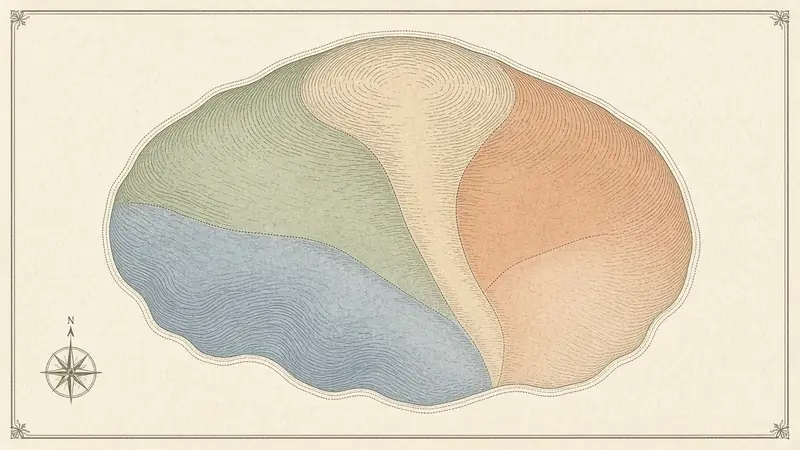
The schematic is a top-down head, not a life drawing. “Front” is the first stretch of a mid-line part and the hairline it meets. “Part” is the mid-scalp line. “Crown” is the vertex, slightly behind that line, which you often cannot see without a photograph from behind. The temples and the edges are the corners and the margins where styles pull. “All over,” “lengths,” and “mainly in photographs” are not drawn as territories because they are ways of seeing the whole head, not a patch on the map. If you are not sure, choose the region you notice most often, and let the lookalike tables on the atlas pages do the rest of the work.
Questions people actually ask
Why can I not get a stage number from this tool?
Staging systems such as Norwood and Ludwig were designed for clinicians looking at a real scalp, and even then they have limits, especially in women and in people whose pattern does not match the original drawings. A self-click tool that issued a stage would be pretending to a precision it does not have. The scales page explains the grades without asking you to assign one to yourself from memory.
Will this try to sell me a product?
The result points at atlas and care pages. Some care pages include a disclosed Advanced Trichology link. The Map itself does not insert a product.
Sources
- Olsen EA. The midline part: an important physical clue to the clinical diagnosis of androgenetic alopecia in women. J Am Acad Dermatol. 1999;40(1):106–109.
- Ludwig E. Classification of the types of androgenetic alopecia occurring in the female sex. Br J Dermatol. 1977;97(3):247–254.
- Norwood OT. Male pattern baldness: classification and incidence. South Med J. 1975;68(11):1359–1365.
- American Academy of Dermatology. Hair loss resource center (public information).