Home / Measure / Norwood and Ludwig, and their limits
Measurement
Norwood and Ludwig, and their limits
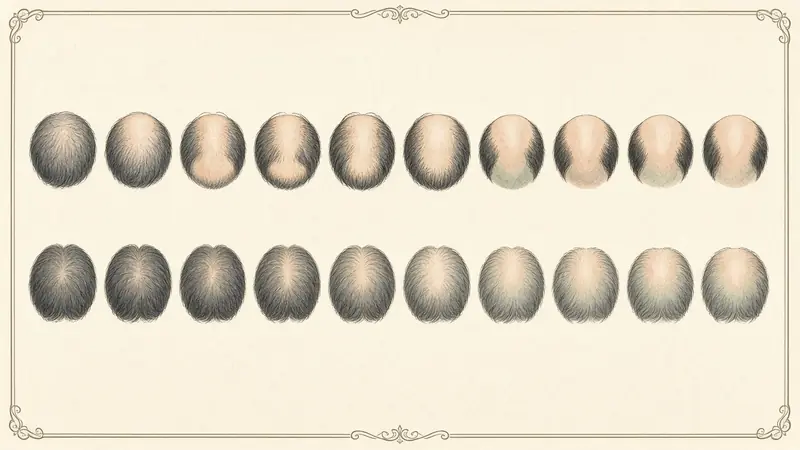
What the scales are
The Norwood scale (sometimes called Hamilton–Norwood) and the Ludwig scale are the two drawings most of the public has seen. They are staging systems for patterned hair loss, designed by clinicians looking at many scalps, and they are still used in papers, in clinic notes, and on the internet. They are also incomplete. They do not cover every pattern, they are easy to misapply from memory, and they are not a diagnosis by themselves. This page explains what they were for, and where they run out, without asking you to assign yourself a stage from a bathroom mirror.
Norwood, in plain language
Hamilton mapped patterned loss in men in 1951. Norwood revised that map in 1975 after looking at a thousand men. In his types, I is minimal or no recession; II is triangular frontotemporal recession; III is the deeper temple recession he considered the minimum to call baldness, with a type III vertex in which the crown thins first; IV and V describe the front and the crown growing toward each other with a thinning band between them; VI is the loss of that band; VII is a remaining horseshoe of hair at the sides and back. There are also type A variants in which the front edge moves back more evenly. The scale is detailed, and later reviewers have called it both indispensable and, at times, cumbersome.
Ludwig, in plain language
Ludwig, in 1977, described three grades of patterned thinning in women, from a study of 468 women: a perceptible thinning of the crown, limited in front by a line a little behind the frontal hairline (I); a more pronounced rarefaction of that same zone (II); and a bare area in that zone (III). He emphasized that a frontal fringe is often preserved. He did not originally incorporate the front-heavy “Christmas tree” accentuation that Olsen later highlighted, and he did not classify women who present with a more male-type recession. Later systems have tried to make room for both.
| What the scales are good for | What they are not good for |
|---|---|
| A shared language in a clinic note or a paper | A self-diagnosis from a single photograph, especially a flash photograph |
| A rough sense of how a pattern is arranged (temples, crown, top) | A complete map of every person, including many women and many mixed pictures |
| A way to read a sentence such as ‘Norwood III vertex’ | A promise about what will happen next, or about what a product will do |
Limits you should keep on
Classification reviews, including Gupta and Mysore (2016), walk through the later alternatives, including systems that try to handle female patterns more flexibly, and they are honest about the trade-offs. A scale can be too simple or too detailed. It can miss a scarring disease that happens to sit in a patterned zone. It cannot, from a website, look at your scalp. If a tool on the internet offers to stage you from a click, it is offering a convenience, not a finding.
If you want to use the drawings at all at home, use them as a vocabulary for a conversation with a clinician, and keep comparable photographs as the actual record. Do not promote yourself a type because a bad picture looked like type IV on a Tuesday.
When a scale should turn into an appointment
If you are reading this because a pattern is appearing, an examination is more useful than a self-score. A dermatologist, or a trichologist at trichology.com, can say whether the picture is a pattern, a shed, a traction margin, or something else. The scales will still be there after that appointment, and they will mean more.
Questions people actually ask
Which scale should a woman use?
Ludwig is the one most often cited for a crown-and-part picture with a preserved fringe. Some women present more like a Norwood drawing. A clinician can say which language fits; a website should not force one.
Is type III ‘the start of baldness’?
It is the point Norwood called the minimum to be considered baldness in his system. That is a historical definition, not a verdict on anyone’s appearance, and earlier types can already be a reason to be seen.
Keep reading
Sources
- Norwood OT. Male pattern baldness: classification and incidence. South Med J. 1975;68(11):1359–1365.
- Hamilton JB. Patterned loss of hair in man: types and incidence. Ann N Y Acad Sci. 1951;53(3):708–728.
- Ludwig E. Classification of the types of androgenetic alopecia occurring in the female sex. Br J Dermatol. 1977;97(3):247–254.
- Olsen EA. The midline part: an important physical clue to the clinical diagnosis of androgenetic alopecia in women. J Am Acad Dermatol. 1999;40(1):106–109.
- Gupta M, Mysore V. Classifications of patterned hair loss: a review. J Cutan Aesthet Surg. 2016;9(1):3–12.