Home / Compare / Mature vs receding hairline
Is it this or that?
Mature vs receding hairline
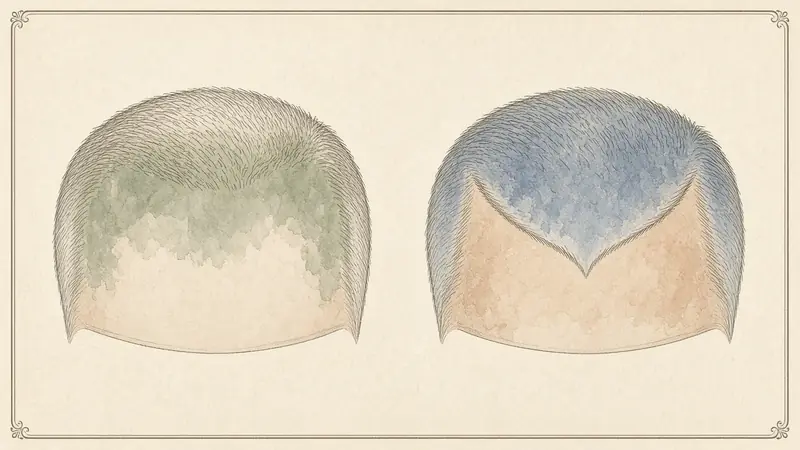
What a mature hairline is
Most people are born with a low, straight or rounded juvenile hairline. In late adolescence and early adulthood, especially in men, that line usually moves up a little and the temple corners soften back. Rassman and colleagues described this as normal hairline maturation: a modest, fairly even change that settles, rather than a progressive loss (Rassman, 2013). Women's hairlines change too, though usually less, and many women keep their frontal hairline even when the top of the scalp thins (Olsen, 2001).
What a receding hairline is
A receding hairline keeps moving. The classic male pattern deepens at the temples into an M shape, then may join thinning further back, as the Hamilton and Norwood scales were drawn to show (Hamilton, 1951; Norwood, 1975). Hairs in the receding zone often become finer and lighter before they disappear, which is why fine wispy hairs at the front edge are a useful sign.
Side by side
| Feature | Mature hairline | Receding hairline |
|---|---|---|
| Change over time | A modest shift that settles | Continues to move over months and years |
| Shape | Even, with softly rounded temples | Deepening triangles at the temples, an M shape |
| Hairs at the edge | Similar thickness to those behind them | Finer, wispy, lighter hairs along the front |
| Symmetry | Usually symmetrical | Usually symmetrical too, which is why shape and progress matter more |
| Eyebrows | Unchanged | Unchanged in pattern loss; thinning brows with a receding band are a red flag |
How to check yours
- Pull hair straight back with a wide-tooth comb so the whole frontal line is visible, and photograph from the front and each side at eye level, in window light.
- Find an old photo with your hair pulled back, ideally from several years ago, at a similar angle.
- Place the tip of a finger on the highest forehead crease and note where the hairline sits relative to it, and how deep each temple corner goes.
- Repeat the same three photos every six months. A mature hairline will look the same across two or three sets; a receding one will not.
When it is neither
Some hairline changes are not pattern changes at all. Frontal fibrosing alopecia, first described by Kossard in postmenopausal women and now recognized more widely, causes a band of hairline recession with smooth, slightly pale skin, often together with thinning eyebrows (Kossard, 1994). Traction from tight styles thins the edges along the path of the pull. Both need a different response from patterned thinning, and frontal fibrosing alopecia needs a professional early because scarring does not regrow.
The temples, changing hairline and edges pages cover each picture in detail. If your hairline looks like it is still moving, the quiz below can help you think through supportive options.
Why the difference matters
The two pictures lead to different decisions. A mature hairline needs nothing more than reassurance and, perhaps, a haircut that suits the new shape. A receding hairline is a pattern change, and people who want to support the hair they have usually do better when they start while the hairs at the edge are still present, even if fine. Knowing which you have also stops a common cycle of worry: checking the temples in every mirror, every day, under every light. Two careful photo sets six months apart, taken the same way, answer the question far more reliably than daily checks, and they give you something concrete to show a professional if you decide to book an appointment.
When to see a professional
See a dermatologist, or a trichologist listed at trichology.com, if the hairline is moving quickly, if the skin there looks smooth, shiny or red, if your eyebrows are thinning, or if the change began after a tight style and has not recovered.
Which kind of support fits you?
For a gradual change at the part, crown or temples. Four one-tap questions. Nothing is stored.
A reading of a picture, not a diagnosis. Your answers stay on this page and are never stored.
Questions people actually ask
At what age does a hairline mature?
Most commonly in the late teens and twenties, especially in men. The key feature is that it settles; a hairline that keeps moving over several years is more likely to be receding.
Is a widow's peak a sign of a receding hairline?
Not on its own. Many people have a natural widow's peak. What matters is whether the temple corners on either side are deepening over time.
Keep reading
Sources
- Rassman WR, Pak JP, Kim J, Estrin NF. Phenotype of normal hairline maturation. Facial Plast Surg Clin North Am. 2013;21(3):317–324.
- Hamilton JB. Patterned loss of hair in man: types and incidence. Ann N Y Acad Sci. 1951;53(3):708–728.
- Norwood OT. Male pattern baldness: classification and incidence. South Med J. 1975;68(11):1359–1365.
- Olsen EA. Female pattern hair loss. J Am Acad Dermatol. 2001;45(3 Suppl):S70–S80.
- Kossard S. Postmenopausal frontal fibrosing alopecia: scarring alopecia in a pattern distribution. Arch Dermatol. 1994;130(6):770–774.