Home / See / A changing front hairline
Presentation
A changing front hairline
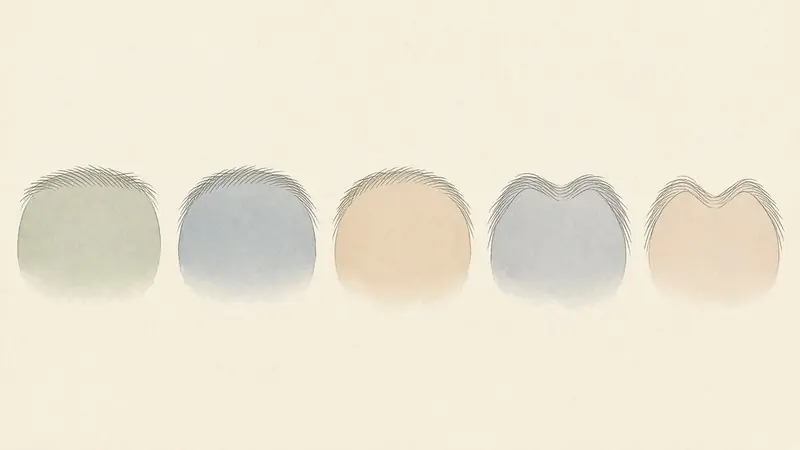
What this looks like
A changing front hairline is a movement or a thinning of the edge where hair meets forehead, not only at the corners and not only at a mid-line part. The whole edge may have crept up. The mid-front may have thinned while the corners stayed, or the opposite. Baby hairs may be present, or the edge may look abrupt. People argue with their own childhood photographs, which is sometimes fair and sometimes a comparison of a seven-year-old hairline with a forty-year-old forehead.
This page sits between temple recession and traction at the edges, because the front edge can be any of those, a mature hairline, or a patterned change that includes the fringe. Women with a Ludwig-type picture often keep a frontal fringe even as the part widens; a breach of that fringe is one reason Olsen’s Christmas-tree description mattered. A hairline that is being pulled by styles or by extensions is a different story with a different urgency.
What it can be confused with
| Lookalike | How it overlaps | A useful distinction |
|---|---|---|
| A mature hairline | Both leave the childhood hairline behind. | A mature change is usually modest, early-adult, and then stable. A travelling edge, or an edge with many miniaturized hairs, is not automatically ‘just maturity.’ |
| Temple recession as the main event | The front edge includes the corners. | If the mid-front is stable and the corners are moving, start with the temples page. |
| Traction or a tight style | The edge is exactly where tension lives. | A history of tight buns, braids, weaves or extension glue, and a thinning that follows that tension, should be read as traction until a professional says otherwise. |
| Frontal fibrosing alopecia or another scarring process | The hairline moves back, often fairly evenly, and eyebrows may also be involved. | A band-like recession, loss of eyebrows, or a pale, tight-looking band of skin is not a vanity problem. It needs a clinician. |
How to photograph this view
Face a window. Take a full-face photograph and a true profile of each side, with the hair worn as usual and, in a second labelled set, gently pulled back so the edge is visible. Include the eyebrows. Do not raise or lower the camera between visits; a slightly downward camera makes a hairline look higher. If you have an old photograph in similar light, keep it beside the new one rather than cropping the old one to flatter or to alarm yourself.
What the literature actually says
Hamilton and Norwood mapped frontotemporal recession in men in detail; they spent less time on a uniformly rising mid-front, which appears in some later variants and in some women. Ludwig emphasized a preserved frontal fringe in the classic female pattern. Olsen noted that frontal accentuation can involve some breach of that fringe. Later reviews add patterns such as a more even recession, and they discuss scarring conditions that target the hairline, including frontal fibrosing alopecia, which is a different disease and not a “stage” of ordinary pattern thinning.
The practical consequence for a reader is simple. A changing hairline is a picture that several processes can draw. The photograph is to see whether the edge is moving and what the skin looks like. The name of the process, if it is to be named, belongs to a person who can examine you.
When to see a professional
A rapidly rising hairline, a band-like recession, eyebrow loss, a tight or inflamed edge, or a strong history of traction should not be watched for a year in private. See a dermatologist, or a trichologist at trichology.com. If the picture is a slow, patterned recession of the corners, the pattern support page is written as support after that reading, not as a way to avoid the appointment.
Which kind of support fits you?
For a gradual change at the part, crown or temples. Four one-tap questions. Nothing is stored.
A reading of a picture, not a diagnosis. Your answers stay on this page and are never stored.
Questions people actually ask
My hairline is higher than in photos from school. Is that recession?
Not necessarily. Many people leave a juvenile hairline behind in late adolescence. Compare more recent photographs, and look at whether the edge is still travelling.
I have lost some eyebrows as well. Is that on this page?
Eyebrow loss with a moving hairline is a reason to see a clinician promptly, because some of the lookalikes involve more than the scalp. This page cannot sort that for you.
Keep reading
Sources
- Norwood OT. Male pattern baldness: classification and incidence. South Med J. 1975;68(11):1359–1365.
- Hamilton JB. Patterned loss of hair in man: types and incidence. Ann N Y Acad Sci. 1951;53(3):708–728.
- Ludwig E. Classification of the types of androgenetic alopecia occurring in the female sex. Br J Dermatol. 1977;97(3):247–254.
- Olsen EA. The midline part: an important physical clue to the clinical diagnosis of androgenetic alopecia in women. J Am Acad Dermatol. 1999;40(1):106–109.
- Gupta M, Mysore V. Classifications of patterned hair loss: a review. J Cutan Aesthet Surg. 2016;9(1):3–12.
- American Academy of Dermatology. Hair loss resource center (public information).