Home / Quiz
The Capellum quiz
What is changing in your hair?
The Capellum quiz
Five questions, one tap each, about a minute. Nothing is stored.
A reading of a picture, not a diagnosis. Your answers stay on this page and are never stored.
How the quiz works
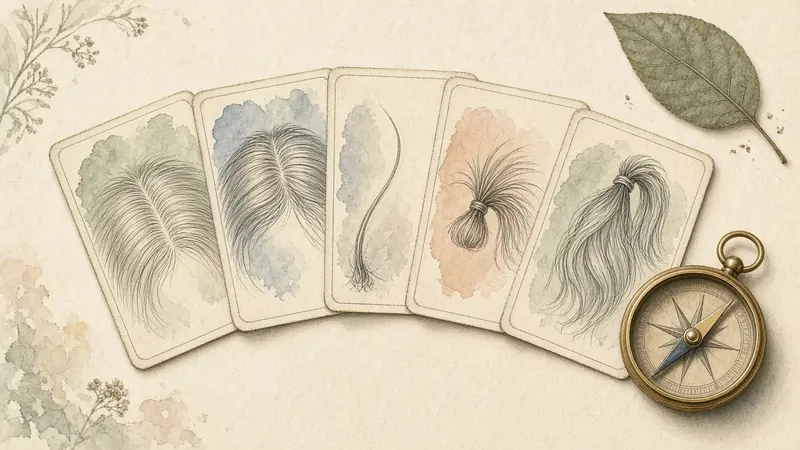
The quiz asks the same questions a careful observer would ask before reading any hair page: where the change is, how fast it arrived, what the short hairs look like, and whether there are any signs that need a professional straight away. Each answer adds weight to one or more of the presentations in the atlas, such as a widening part, a crown change, temple recession, a diffuse change, breakage in the lengths, or an effect of light. The presentation with the most weight becomes your reading. The last question asks what kind of routine you would actually keep up, so that the suggested first step fits your life rather than an ideal one.
All of this happens in your browser. There is no account, no cookie, no email capture, and nothing is sent anywhere. Close the page and your answers are gone.
What the results mean
A result is a reading of a picture, not a diagnosis. It names the presentation your answers point to, links to the atlas page that describes it in detail, including its lookalikes, and suggests one first step from Advanced Trichology that suits the picture and the routine you chose. Where testing is the honest first step, as it is for most diffuse changes, the suggestion is a blood panel rather than a product. Iron and vitamin D supplements are only ever suggested when you tell the quiz that a clinician has already confirmed a deficiency.
If you answer yes to any of the safety signs (sudden round patches, a sore, burning, scaly or shiny scalp, or loss of eyebrows or lashes), the quiz stops suggesting products and points you to a professional instead. Those signs can have causes that need prompt, specific care.
After the quiz
Whatever your result, the most valuable thing you can do next is start a fair record. Take a standard set of photographs on clean, dry hair, in window light, from the same angles, and repeat them every three months. The comparable photos page shows how. If you start a new product, that record is how you will see the difference it makes. If you see a professional, it gives them a timeline that memory cannot.
You can retake the quiz as often as you like. If your answers change because the picture has changed, that is useful information. If they change because you are having a worried day, return to your photographs instead. If you book an appointment, bring the result and your photographs with you: a clinician can confirm or change the reading after an examination, which no quiz can do.
Shorter quizzes in the atlas
Several atlas pages carry a shorter quiz focused on one question: is my part widening?, which kind of support fits you?, what is a sensible first step for diffuse thinning?, roots, lengths or fiber? and is it the light or the hair? Each works the same way and stores nothing.
Prefer to point at a drawing? The Capellum Map lets you mark the area on a schematic of the scalp. For side-by-side help with common mix-ups, see Is it this or that?
Questions people actually ask
Is the quiz a diagnosis?
No. It reads the picture you describe and points you to the right atlas page and a sensible first step. A dermatologist or trichologist can examine your scalp and give a diagnosis.
Why does the quiz suggest a product?
Each result suggests one item that fits the picture and the routine you chose, or a blood panel when testing is the better first step.
Does the quiz store my answers?
No. It runs entirely in your browser, uses no cookies and sends nothing anywhere.
Sources
- Olsen EA. The midline part: an important physical clue to the clinical diagnosis of androgenetic alopecia in women. J Am Acad Dermatol. 1999;40(1):106–109.
- Headington JT. Telogen effluvium: new concepts and review. Arch Dermatol. 1993;129(3):356–363.
- Norwood OT. Male pattern baldness: classification and incidence. South Med J. 1975;68(11):1359–1365.
- American Academy of Dermatology. Do you have hair loss or hair shedding? (public information).
- Canfield D. Photographic documentation of hair growth in androgenetic alopecia. Dermatol Clin. 1996;14(4):713–721.