Home / See / Thinning that shows under direct light
Visual long tail
Thinning that shows under direct light
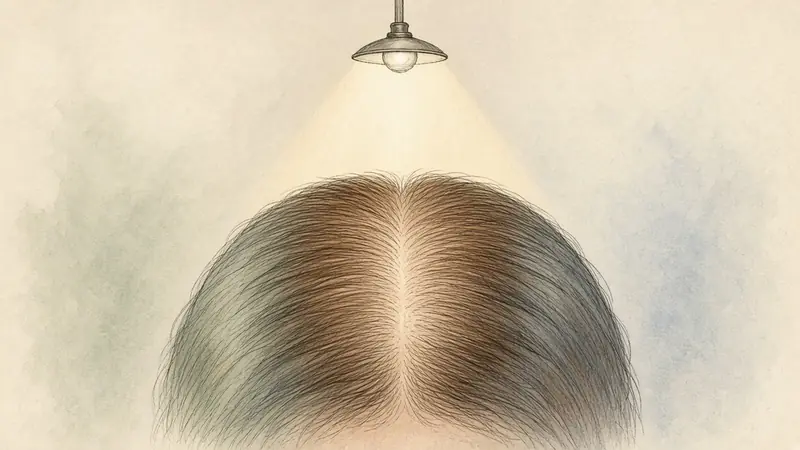
What you are seeing
You stand under a bathroom downlight, a lift's ceiling panel, or a restaurant spotlight, glance up into a mirror, and the top of your head looks thinner than it did at home that morning. The part seems to glow. The crown shows a pale patch you have never noticed. Then you step outside and it is gone. This is one of the most common reasons people start searching for hair loss, and in many cases the hair has not changed at all between the two rooms.
A single, hard light source placed directly above the head does three things at once. It shines straight down the gaps between hairs, so the scalp is lit rather than shaded. It reflects off the skin, which is smoother and shinier than hair, so the scalp looks brighter than its real tone. And it throws the hair at the sides into shadow, which makes the lit top look even paler by contrast. None of those effects needs a single hair to be missing.
Why overhead light exaggerates
Hair hides the scalp mainly by overlapping and casting shade. Light that arrives from the side, such as a window, has to cross many hairs before it reaches skin, so the scalp stays in their shadow. Light that arrives from directly above travels along the same path the hairs grow, so far fewer fibers stand in the way. Clinical photographers learned this decades ago, which is why standardized hair photography fixes the light, the angle and the distance before anyone compares two images (Canfield, 1996).
Color matters too. Dark hair over light skin gives the strongest contrast, so overhead light makes show-through very obvious. Very fair or grey hair over fair skin can hide a real change in the same light, which is why the blonde hair page is a mirror image of this one.
A fair test in five minutes
- Use clean, fully dry hair with no product. Part it where you usually wear it.
- Stand side-on to a window in daylight, with overhead lights switched off.
- Hold your phone at arm's length above the head, lens parallel to the scalp, and take one picture. Then take a second with the ceiling light on and the window covered.
- Compare the two side by side. The difference between them is the light, not your hair.
- Keep the window picture as your baseline and repeat it in three months, as described in comparable photos.
When it may be more than the light
| What you notice | Points toward lighting | Points toward a real change |
|---|---|---|
| The part glows under a downlight | It looks normal by a window and in older window-lit photos | It is also wider in window light than in a photo from a year ago |
| A pale circle at the crown | It moves when you tilt your head or change the light | It stays in the same place and size in every light, and the hairs there look finer |
| Front of the part looks thin | Only from above, only under spotlights | The show-through is broadest at the front in any light: read the Christmas tree page |
| Sudden change noticed in one evening | Nothing else is different: no shedding, no new trigger | There is also more hair in the drain, two to four months after an event |
If the window picture also shows a wider part or a thinner crown than an older window picture, the light was only the messenger. Read the widening part or crown page next, and use the short quiz on this page to sort the picture.
When to see a professional
Lighting never causes soreness, scaling, redness, or round bald patches. If you see any of those, or if hair is coming out in clumps, book a dermatologist or a trichologist listed at trichology.com rather than taking more photographs.
Is it the light or the hair?
Four one-tap questions. Nothing is stored.
A reading of a picture, not a diagnosis. Your answers stay on this page and are never stored.
Questions people actually ask
Why does my hair look thinner in the bathroom mirror than anywhere else?
Most bathrooms have a strong light directly overhead and a mirror that shows you the top of your head at close range. That combination lights the scalp between the hairs and makes it look brighter. Check the same part by a window before deciding anything has changed.
Is it normal to see my scalp under bright light?
Yes. Almost everyone shows some scalp along a part or at the crown whorl under a hard overhead light, especially with dark hair. What matters is whether the picture in fair, consistent light has changed over months.
Keep reading
Sources
- Canfield D. Photographic documentation of hair growth in androgenetic alopecia. Dermatol Clin. 1996;14(4):713–721.
- Olsen EA. The midline part: an important physical clue to the clinical diagnosis of androgenetic alopecia in women. J Am Acad Dermatol. 1999;40(1):106–109.
- Birnbaum MR, McLellan BN, Shapiro J, Ye K, Reid SD. Evaluation of hair density in different ethnicities in a healthy American population using quantitative trichoscopic analysis. Skin Appendage Disord. 2018.
- American Academy of Dermatology. Hair loss resource center (public information).