Home / See / Photo vs mirror: why they disagree
Visual long tail
Photo vs mirror: why they disagree
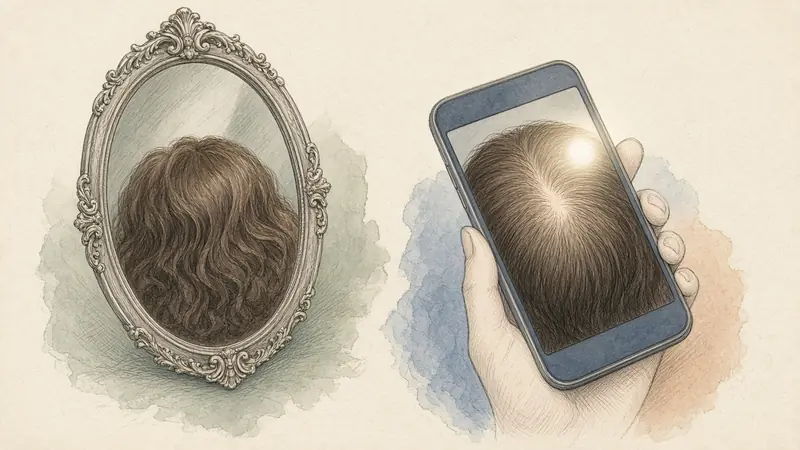
What you are seeing
In the mirror your hair looks fine. In a photograph someone took of you at a party, or a video call thumbnail, or a picture from behind, it looks thin. Both images are of the same head on the same day. The difference is in the way each one is made, and in the views each one gives you, rather than in your hair.
Why the two views disagree
Angle. A mirror shows you the front and sides, from eye level, which is where hair is usually fullest. Photographs, especially those taken by someone standing while you sit, look down at the part and crown, a view you almost never see for yourself.
Light. At home you check the mirror in familiar, often soft light. Photographs are taken under whatever is there: flash, downlights, harsh sun. Flash fires straight at the head and lights the scalp between hairs.
Lens and distance. Phone cameras use wide-angle lenses. Held close, they enlarge whatever is nearest the lens, which in a top-down shot is the crown or the part. Many phones also sharpen and brighten automatically, which can increase the contrast between hair and skin.
Familiarity. You see your mirror image every day and adapt to it. A photograph of an angle you rarely see feels like new information, even when it is not.
None of this means photographs lie about everything. Clinical hair photography exists because a standardized photograph is more reliable than a memory, or a mirror (Canfield, 1996). The point is that one casual picture is a poor record, and a series taken the same way is a good one.
Make photos and mirror agree
- Take your own set of standard views: front hairline, part from above, crown from above and behind, each temple. Use window light, dry hair, the same part, and the same distance.
- Use a phone stand or a second person, and keep the phone at least arm's length away to reduce wide-angle distortion.
- Turn off flash and beauty filters.
- Repeat every three months and compare set with set. The protocol is on comparable photos.
When the photo is telling you something
| What you notice | Probably the camera | Probably a real change |
|---|---|---|
| Crown looks thin in a picture from behind | Flash or a downlight, one picture only | Your own standard crown photos show it widening over months |
| Part looks wide in a group photo | Taken from above, close, with flash | Also wider in your standard window-light part photo |
| Hairline looks higher | Hair pushed back, wide-angle lens close to the face | Temples have moved back compared with older standard photos |
| Overall thinner in videos | Compression and low light | Ponytail circumference or part width have also changed |
If your standard set confirms a change, read the page for the view that changed: crown, part or temples.
Why one bad photo is not a verdict
It is very common to see an unflattering photo and feel alarmed. That reaction is worth taking seriously, because it is often the push people need to start a fair record, but the photo itself is rarely the evidence. Think of it as a question rather than an answer. Set up your standard views within the week, keep them, and repeat them on a calendar reminder three months later. Most people find one of two things: the standard views are stable and the worrying photo was a trick of light and lens, or the standard views confirm a slow change that they can now follow calmly. Either way, the decision you make next is based on a record instead of a single moment.
When to see a professional
A dermatologist, or a trichologist listed at trichology.com, can examine the scalp with magnification, which neither a mirror nor a phone can replace. Go sooner for patches, soreness, scale, or fast loss.
Is it the light or the hair?
Four one-tap questions. Nothing is stored.
A reading of a picture, not a diagnosis. Your answers stay on this page and are never stored.
Questions people actually ask
Which is more accurate, a photo or the mirror?
Neither on its own. A single casual photo exaggerates, and the mirror hides the crown and part. A set of standard photos taken the same way over months is the most accurate record you can make at home.
Why does my crown look so thin in pictures from behind?
The crown whorl naturally shows some scalp, and pictures from behind are often taken from above with flash. Compare with your own standard crown photos before deciding it has changed.
Keep reading
Sources
- Canfield D. Photographic documentation of hair growth in androgenetic alopecia. Dermatol Clin. 1996;14(4):713–721.
- Olsen EA. The midline part: an important physical clue to the clinical diagnosis of androgenetic alopecia in women. J Am Acad Dermatol. 1999;40(1):106–109.
- Shapiro J. Hair loss in women. N Engl J Med. 2007;357(16):1620–1630.
- American Academy of Dermatology. Hair loss resource center (public information).