Home / See / A widening midline part
Presentation
A widening midline part
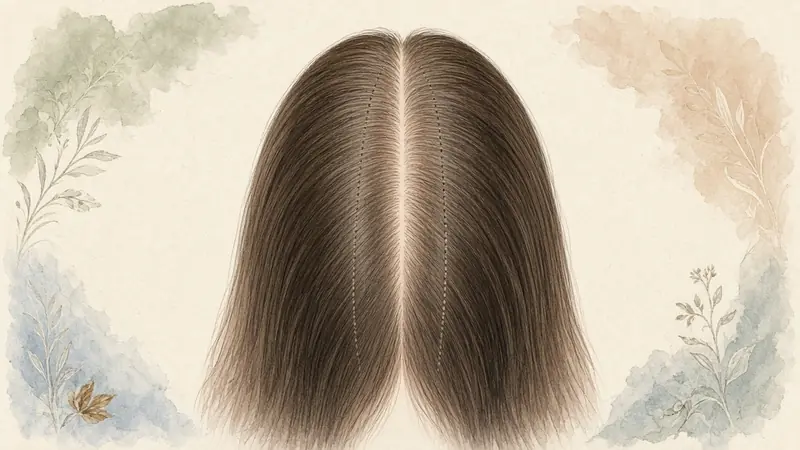
What this looks like
A widening midline part is exactly what it sounds like: the line you draw with a comb, usually down the centre, shows more scalp than it used to, and the width of that pale line has grown. It is often noticed first in a harsh overhead light, in a flash photograph, or by a hairdresser looking down at the crown. The front hairline may still look familiar, which is why this presentation can go on for a long time before anyone names it.
The useful comparison is not with a stranger and not with a memory of “how thick my hair used to be.” It is with an older photograph of your own part, taken from above, or with the part you can make further back toward the crown. If the line is clearly broader in front than it is further back, read the Christmas tree page as well. If the change is even from front to back, stay on this page and add how to measure a part fairly.
What it can be confused with
| What you might be seeing | Why it can look like a widening part | What usually helps tell them apart |
|---|---|---|
| A patterned thinning on the top of the scalp | This is the presentation Olsen highlighted as a physical clue in women. | A gradual course, a preserved front hairline, and finer hairs along the part all point this way, and still need a clinician to confirm. |
| A Christmas-tree, or frontal-accentuation, pattern | The same part is simply wider at the front than at the back. | A top-down photograph usually shows a triangular patch of show-through. See the Christmas tree page. |
| A diffuse shed after a trigger | When many hairs are in a resting phase, a part can look wider even if the pattern has not changed. | The change is faster, often two to four months after a birth, illness, medicine or other event, and it is not confined to the part. Use Hair Experts for the timeline. |
| Breakage along a habitually combed line | Repeated tension and backcombing can shorten hairs along a hard part, so more scalp shows. | The short hairs have blunt ends, and the part looks better when you place it somewhere else. See breakage versus thinning. |
| A scarring process on the crown, including central centrifugal cicatricial alopecia in some tightly coiled hair | A widening part on the vertex can be the first thing a person notices. | The scalp may look shiny, inflamed, or tender, and hairs may be lost in a way that does not grow back. This needs a professional promptly, not a new shampoo. |
How to photograph this view
Wash and dry the hair. Do not add powder, spray, or a root concealer. Stand under a single, consistent light. A window at the same time of day is better than a bathroom bulb that you will change later. Part the hair in the place you usually wear it, then take a photograph from directly above, camera parallel to the scalp, with a small object of known size (a paperclip, a ruler) in the frame. Repeat the same part, the same light, and the same distance the next time. A second photograph with the part moved one centimetre to the left tells you whether the show-through follows the comb line or the scalp.
Do this every three months unless a clinician has asked for a tighter interval. Weekly photographs mostly record the weather and the flash. The longer protocol lives on comparable photos.
What the literature actually says
In 1999, Elise Olsen published a short paper arguing that the midline part is an important physical clue to the clinical diagnosis of androgenetic alopecia in women. The observation is simple and it has lasted: looking down at a central part, rather than only at the hairline, is often how female-pattern thinning first becomes visible. Olsen also described a frontal-accentuation variant, the Christmas-tree pattern, in which the show-through is broader toward the front of that part. Those are clinical descriptions of a picture. They are not a rule that every widening part is patterned hair loss.
Ludwig’s 1977 scale, still widely used, grades female-pattern thinning as a progressive rarefaction over the crown with a preserved frontal fringe. Grade I is already “perceptible thinning” in that zone. A widening part can be the way a person first notices a Ludwig-type change, but the scale itself is assigned by someone looking at the scalp, not by a website, and it does not cover every pattern women get, including a more male-type recession, which Olsen and later reviewers have been careful to mention.
Density itself is not a single normal number. It varies by ancestry, by site, and by age. A widening part is a change in the appearance of one line, not a hairs-per-square-centimetre count. If you want the limits of home density checks, they are on their own page.
When to see a professional
See a dermatologist, or a trichologist listed at trichology.com, if the part is widening quickly, if the scalp is sore, itchy, shiny or inflamed, if the change is happening in tightly coiled hair on the crown, or if you simply want a diagnosis rather than a better photograph. A widening part is a reason to look, not a reason to self-treat as if the cause were already known.
If the widening arrived on a schedule after a specific event, read diffuse thinning and then the Shed Clock on Hair Experts. Care that assumes a pattern, including the page on supporting patterned thinning, is for after the picture has been read honestly, and never in place of a clinician when a scarring process is possible.
Is my part widening?
Four quick questions, one tap each. Nothing is stored.
A reading of a picture, not a diagnosis. Your answers stay on this page and are never stored.
Questions people actually ask
Can a part look wider on some days and narrower on others?
Yes. Wet hair, a different parting, a new cut, and a harsher light will all change how much scalp you see. That is why a single photograph is a poor record and a comparable set is a better one.
Does a widening part always mean I will go bald on top?
No. Many people have a slowly widening part that remains a part. The course depends on the cause, which this page cannot name for you, and on what, if anything, is done about it with a clinician.
Keep reading
Sources
- Olsen EA. The midline part: an important physical clue to the clinical diagnosis of androgenetic alopecia in women. J Am Acad Dermatol. 1999;40(1):106–109.
- Olsen EA. Female pattern hair loss. J Am Acad Dermatol. 2001;45(3 Suppl):S70–S80.
- Ludwig E. Classification of the types of androgenetic alopecia occurring in the female sex. Br J Dermatol. 1977;97(3):247–254.
- Gupta M, Mysore V. Classifications of patterned hair loss: a review. J Cutan Aesthet Surg. 2016;9(1):3–12.
- American Academy of Dermatology. Hair loss in women: common causes and treatment (public information).