Home / Measure / Measuring a part fairly
Measurement
Measuring a part fairly
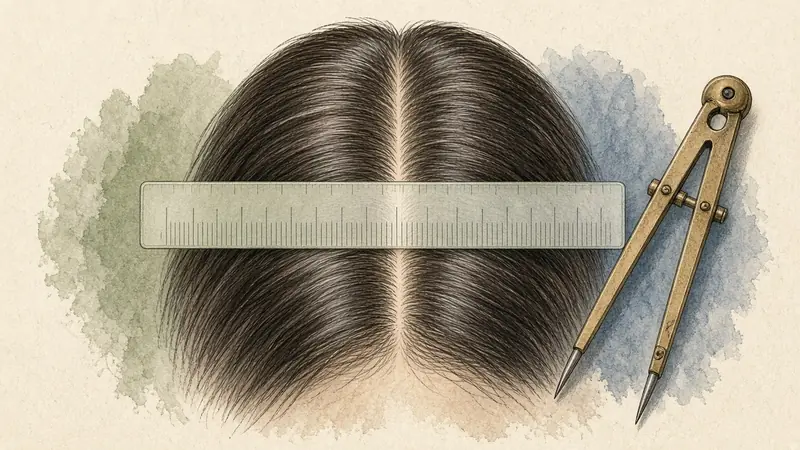
What you are measuring
Part width is the apparent width of a line of scalp, usually along the mid-line, as seen from above. It is not a density. It is not a Ludwig grade. It is a way of putting a number, or at least a comparable mark, on a presentation that people already notice: the part looks wider than it used to. The number will move with light, with colour contrast, with how hard you press the comb, and with how dry the hair is. The only honest use of it is as a comparison with yourself, under the same conditions.
A method you can repeat
Wash and dry the hair. Do not add concealer. Stand under a window at a time of day you can repeat. Comb a mid-line part in the place you usually wear it, with the same kind of comb and a similar pressure. Do not press harder to “make it clear.” Lay a paper ruler, or a piece of paper with millimetre marks, across the part at two agreed stations: one about two centimetres behind the front hairline, and one further back toward the mid-scalp. Photograph from directly above, camera parallel to the scalp, so that the ruler and the part are both in focus. Read the width at each station from the photograph, not from the mirror, and write the two numbers down with the date.
If the front station is clearly wider than the back, you may also be looking at a Christmas-tree shape; keep both numbers anyway. Repeat in three months with the same stations. Weekly measurements will mostly record how you combed.
What this method cannot do
| Temptation | Why it is a problem |
|---|---|
| Treating a single width as ‘normal’ or ‘not normal’ | There is no universal part-width that the literature agrees on as a diagnostic cut-off, and contrast and styling change the number. |
| Comparing your width with a photograph of a stranger | Hair colour, curl, cut and lighting make other people’s parts a bad control. |
| Pressing the comb harder at the second visit | You can manufacture a wider part with the tool you are using to measure it. |
| Using a wet part in one visit and a dry part in the next | Wet hair clumps and always shows more scalp. |
What the literature actually says
Olsen’s 1999 observation was qualitative: the midline part is a useful physical clue in women. She did not hand the public a millimetre threshold. Ludwig’s grades are also visual, assigned to the crown as a zone, not to a measured line. A part-width record is therefore a home-made aid, in the spirit of those clinical looks, and it should not be dressed up as a clinic endpoint. If a trial or a clinician later measures you with a different method, that method is the trend; this one stays your album.
When a width should turn into an appointment
A part that is widening quickly, a front station that is racing ahead, a tender or shiny scalp along the line, or simply a wish to have the picture named, are all reasons to see a dermatologist or a trichologist at trichology.com. Bring the photographs. They are more useful than the raw millimetres.
A worked example, without a verdict
Suppose the front station reads nine millimetres in March and eleven in June, and the back station stays near six. The front is moving more than the back, which is a reason to look at the Christmas-tree page and to take the next set as seriously as the first. It is not a reason to invent a percentage, and it is not a Ludwig grade. If both stations move a little, or if one visit was wet and the next was dry, you do not yet have a story. You have a reminder to keep the conditions still. If the scalp along the line is sore in either photograph, you have a reason to be seen that does not depend on the millimetres at all.
Questions people actually ask
Do I need a special ruler?
No. A paper ruler, or a printed millimetre scale, is enough. What matters is that the same scale appears in the same place in later photographs.
My two sides of the part are not even.
Measure the apparent width of the line, and also keep the photograph. Asymmetry is information, not a failure of the method.