Home / Measure / A protocol for comparable photos
Measurement
A protocol for comparable photos
Why a protocol exists at all
Hair photographs are unusually easy to fake without meaning to. Flash, wetness, a new angle, a new cut, a darker top, a thickening spray, and a different time of day will all move the appearance of the scalp. Clinical trials that use photographs as an endpoint control those conditions because a modest biological change is smaller, over a few months, than the noise of an uncontrolled camera. You cannot build a studio, but you can borrow the idea of control.
This protocol is the one the rest of the atlas points to. It is not a density measurement, and it is not a diagnosis. It is a way to make next season’s picture talk to this one.
The set
Take at least four views, all on the same day, with dry, clean, unstyled hair and no root concealer, powder, or thickening fiber:
| View | How to stand | What it is for |
|---|---|---|
| Mid-line part, from above | Camera parallel to the scalp, looking down the part from the hairline toward the crown. | Widening parts and Christmas-tree shapes. |
| Crown, from behind and above | Someone else is better. Include a sliver of the back of the head. | Vertex change, and a comparison with the occipital scalp. |
| Both temples, three-quarter or profile | Face a window. Include the eyebrows. | Recession, a mature hairline, and traction at the corners. |
| The back of the head, as a control | The same distance and light as the crown photograph. | A zone that often holds its density longer in patterned change. |
Add a fifth view if a particular edge, a nape, or a mid-length breakage zone is the thing you actually notice. Label every file with the date, the view, and whether the hair is in its usual style or pulled back for the record.
The conditions that make a set comparable
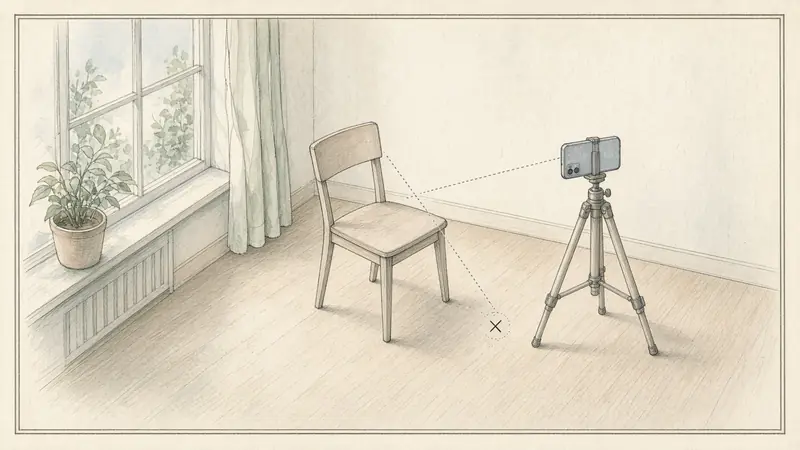
Light: a window, at a time of day you can repeat, no flash. A single overhead bulb is a poor studio, and a flash is how crowns become emergencies. Distance and angle: mark a spot on the floor, or always have the same person stand in the same place. State of the hair: clean, dry, unstyled. Colour of the clothing: avoid a black sweater if you can, or always wear one, but do not switch. A small object of known size in the top-down frames gives you a crude scale.
Interval: for a slow or patterned change, three months is more informative than a weekly shoot, which mostly records the weather. After a sudden shed, follow the advice you have been given and use Hair Experts for the expected course; this protocol is still the way to take the pictures, not the way to date the peak.
What a protocol cannot do
It cannot count hairs per square centimetre, and it cannot replace trichoscopy or a biopsy. It cannot tell a timed shed from a pattern by itself, although a set that includes the back of the head will often hint. It cannot be compared fairly with a clinic photograph taken under different lights. If you already have a clinic method, keep using that method for the trend, and use this set as your own album beside it, not as a rival number.
When a set should turn into an appointment
If the comparable pictures show a change, or if the scalp looks sore, shiny, or patchy in any of them, see a dermatologist or a trichologist at trichology.com. A good set is a gift to that appointment, not a reason to delay it.
Questions people actually ask
Can I use video instead?
A short video can help you find an angle, but stills are easier to compare three months later. If you shoot video, also grab still frames of the four views.
Should I wet my hair to ‘show the scalp clearly’?
No. Wet hair always shows more scalp. If you want a wet set as well, keep it separate and labelled, and never compare a wet picture with a dry one.