Home / See / The Christmas tree pattern
Presentation
The Christmas tree pattern
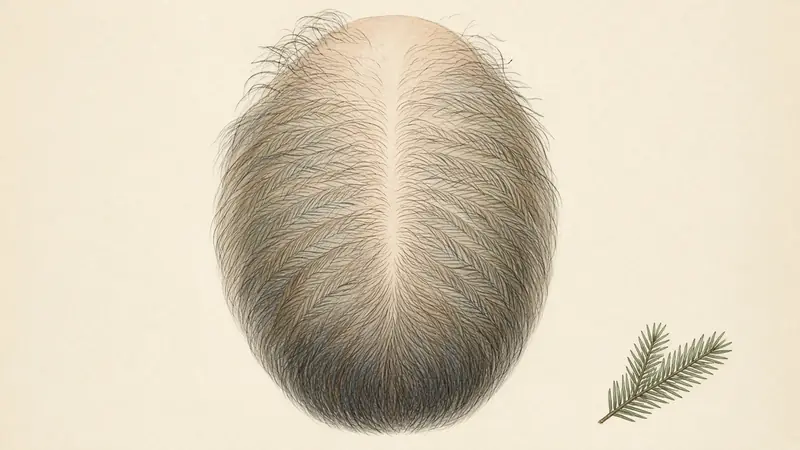
What this looks like
The Christmas-tree pattern is a widening of the central part that is more pronounced at the front than it is further back, so that the patch of visible scalp looks roughly triangular, like a tree seen from above, with its base toward the forehead. The front hairline may still be in place, or it may be a little thinned where the “trunk” of the tree meets the fringe. People often notice it first in a mirror held up to the crown, or in a photograph taken from above by someone else.
This is a shape, not a severity score. A small triangle can be an early picture; a large one can still be a presentation rather than a stage you should assign yourself. If the part is wide but even from front to back, the straighter widening part page is the better first read.
What it can be confused with
| Lookalike | How it overlaps | A useful distinction |
|---|---|---|
| A plain widening midline part | Both are changes along the centre of the top of the scalp. | The Christmas-tree view is broader at the front. A top-down photograph makes that obvious. |
| Ludwig-type thinning over the crown | Both can preserve a frontal fringe while the top rarefies. | Ludwig’s original grades emphasize the crown; Olsen’s frontal-accentuation pattern emphasizes the front of the part. A person can show features of both. |
| Traction from a tight front style | Tension at the front can thin the hair where the ‘tree’ would be. | The history of tight styles, and thinning that follows a hairline or a hard part rather than a tree shape, points toward traction. See the edges page. |
| A photograph taken from too far forward | A camera held out in front of the face looks down the forehead and exaggerates the front of the part. | Take the picture from directly above, with the camera parallel to the scalp. |
How to photograph this view
The only honest photograph of a Christmas-tree pattern is a top-down one. Tilt the chin slightly so that the camera, held by you at arm’s length with the rear camera or by someone else standing above, looks at the mid-sagittal line from the hairline to the crown. Do not use a flash for the record set; flash creates a white path that can mimic a tree. Dry, unstyled hair, the usual part, and a second picture with the hair combed back from the front of the part will show whether the triangle is in the scalp or in the styling.
Keep the first photograph. The next one, taken under the same conditions three months later, is the beginning of a record. A millimetre scale in the frame at the front of the part is enough; you do not need a clinic ruler to see whether the triangle is growing.
What the literature actually says
Olsen’s 1999 paper on the midline part, and her later writing on female pattern hair loss, are the source of the “Christmas tree” language in this context. She described frontal accentuation: thinning that is most obvious at the front of a central part and that can include some breach of the frontal hairline, producing a triangular area of show-through. The point of the description was clinical (it is a physical clue, a way of seeing), not a new disease.
Reviews of classification systems (including Gupta and Mysore, 2016) note that Ludwig’s three grades, important as they are, did not originally capture this frontal accentuation, and that later systems tried to make room for it, and for women who present with a more male-type recession. If a clinician uses a different name or a different scale, they are not necessarily disagreeing with the picture you have; they may be using a later map of the same territory.
None of those papers asks a reader to diagnose themselves from a diagram on a website. The value of the Christmas-tree description for you is narrower: it tells you which photograph to take, and it tells you that a preserved hairline does not rule out a patterned change on the top of the scalp.
When to see a professional
A Christmas-tree view is a reason to be examined if you want a name for it, if it is progressing, or if anything about the scalp itself looks inflamed or shiny. It is also a reason not to assume that a front-heavy part is “just styling.” A dermatologist, or a trichologist at trichology.com, can tell the patterned presentations from the ones that need a different kind of care. Support that assumes a pattern is collected on its own page, and it is not a first step when the scalp may be scarring.
Is my part widening?
Four quick questions, one tap each. Nothing is stored.
A reading of a picture, not a diagnosis. Your answers stay on this page and are never stored.
Questions people actually ask
Is the Christmas-tree pattern only seen in women?
It is discussed mainly as a way female-pattern thinning can look. Men more often present with temple and crown change. Anyone can have a front-heavy part, though, and the photograph is still the right first move.
Does the name mean it is festive or mild?
No. It is only a shape. Severity, if it is to be judged at all, belongs in a clinic, not in the nickname.
Keep reading
Sources
- Olsen EA. The midline part: an important physical clue to the clinical diagnosis of androgenetic alopecia in women. J Am Acad Dermatol. 1999;40(1):106–109.
- Olsen EA. Female pattern hair loss. J Am Acad Dermatol. 2001;45(3 Suppl):S70–S80.
- Ludwig E. Classification of the types of androgenetic alopecia occurring in the female sex. Br J Dermatol. 1977;97(3):247–254.
- Gupta M, Mysore V. Classifications of patterned hair loss: a review. J Cutan Aesthet Surg. 2016;9(1):3–12.