Home / Compare / Normal part vs widening part
Is it this or that?
Normal part vs widening part
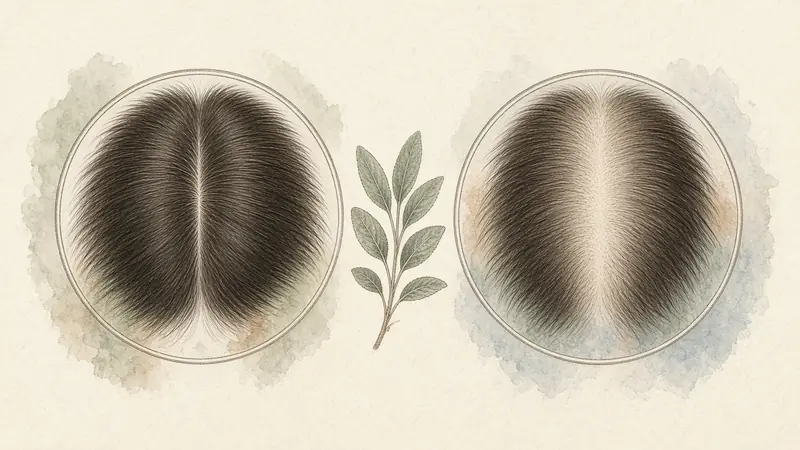
What a normal part looks like
Every part shows some scalp. Drawing a comb through hair lays fibers to either side and exposes a line of skin, and how wide that line looks depends on hair color, diameter, curl, how freshly washed the hair is, and how the light falls. A normal part is usually narrow and fairly even from front to back, with the hair on both sides looking similar in thickness. It also tends to look the same if you move it a centimetre or two to one side.
A normal part can still look wider than you expect under overhead light, in a flash photograph, when hair is wet, or on the second day after washing. Those are covered on the direct light, wet hair and greasy hair pages.
What a widening part looks like
A widening part is a change over time: the pale line is broader than it was in older photographs taken the same way. Elise Olsen described the midline part as an important physical clue to female-pattern thinning, and she also described a variant in which the widening is broadest at the front, the Christmas-tree pattern (Olsen, 1999). In patterned thinning the hairs along the part often become finer and shorter than the hairs at the back of the head, a change clinicians look for with magnification (Rakowska, 2009).
Side by side
| Feature | Normal part | Widening part |
|---|---|---|
| Width over time | Stable in photos taken the same way | Broader than in older comparable photos |
| Shape | Roughly even from front to back | Even, or broadest at the front (Christmas tree) |
| Moved 2 cm to the side | The new part looks about the same | The new part looks narrower than the usual one, or both look wider than before |
| Hairs along the line | Similar in thickness to the rest | A mix of finer, shorter hairs among normal ones |
| Compared with the back of the head | Similar coverage | Noticeably less coverage on top than at the back |
| Depends on light | Yes, strongly | Visible in fair window light as well |
The two-part test
- Wash and fully dry your hair, with no product.
- Part it where you usually do and photograph from directly above in window light, with a ruler or paperclip in the frame.
- Make a second part two centimetres to one side and take the same photo.
- Make a third part at the back of the crown, near the occiput, as a comparison.
- Compare the three. A usual part that looks wider than the test parts may reflect breakage or habit along that line; all parts looking wider than the back suggests a change on top; all looking alike suggests a normal part in unflattering light.
Repeat the same set in three months. Measurement details, including how to read the ruler fairly, are on measuring a part.
What to do with the answer
If your part looks normal, keep your baseline photos and check again in three to six months. If it looks wider, read the widening part page and, if the front is broadest, the Christmas tree page. The short quiz below can help you narrow it down and suggest one supportive next step. A dermatologist or trichologist can confirm the picture with magnification.
When to see a professional
See a professional, for example a trichologist listed at trichology.com, if the part is widening quickly, if the scalp along it is sore, red, scaly or shiny, or if you notice patches elsewhere. In tightly coiled hair, a crown change with tenderness deserves an early visit.
Is my part widening?
Four quick questions, one tap each. Nothing is stored.
A reading of a picture, not a diagnosis. Your answers stay on this page and are never stored.
Questions people actually ask
How wide should a normal part be?
There is no single correct width, because it depends on hair color, diameter, curl and light. Your own older photos, taken the same way, are the right comparison.
Can parting hair in the same place make the part wider?
A habitual part can show more scalp, and repeated tension along it can cause breakage. Moving the part is a simple test: if the new line looks narrower, the old one may be a habit effect rather than a pattern.
Keep reading
Sources
- Olsen EA. The midline part: an important physical clue to the clinical diagnosis of androgenetic alopecia in women. J Am Acad Dermatol. 1999;40(1):106–109.
- Olsen EA. Female pattern hair loss. J Am Acad Dermatol. 2001;45(3 Suppl):S70–S80.
- Rakowska A, Slowinska M, Kowalska-Oledzka E, Olszewska M, Rudnicka L. Dermoscopy in female androgenic alopecia: method standardization and diagnostic criteria. Int J Trichology. 2009;1(2):123–130.
- Canfield D. Photographic documentation of hair growth in androgenetic alopecia. Dermatol Clin. 1996;14(4):713–721.