Home / See / Greasy hair that looks thinner
Visual long tail
Greasy hair that looks thinner
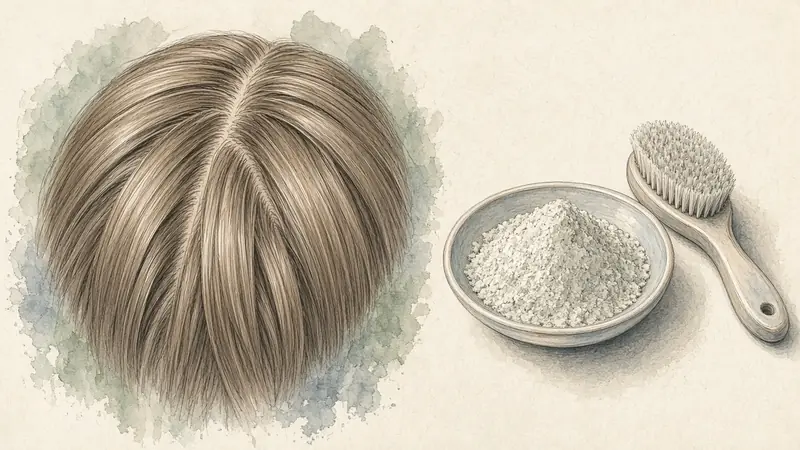
What you are seeing
On the morning after washing, hair looks full. By the second or third day the roots go flat, strands gather into narrow sections, and pale lines of scalp appear along the part and at the crown. People often notice this most in fine, straight hair, and they reasonably wonder whether the hair is thinning or just dirty. Usually it is the oil.
Why oil makes hair look thinner
The scalp produces sebum continuously. Over a day or two it travels down the fibers from the root. Sebum makes neighboring hairs cling together, so a head that covered the scalp as a light, separate layer turns into a set of grouped strands with gaps between them. Oiled hair also lies flatter and reflects light in streaks rather than scattering it, which makes the gaps look larger. Fine hair shows this soonest, because each fiber has less body to resist the weight and less surface for the sebum to spread over (Trüeb, 2007).
Shampoo's main job is to remove that sebum and the debris that comes with it. The right washing rhythm differs from person to person: an oily scalp with fine hair may look best washed daily, while very curly or dry hair may need much less. There is no single correct number of washes a week.
A fair test
- Take your baseline picture on clean, fully dry hair, a few hours after washing, with no oil, serum or dry shampoo.
- Use the same window light and the same part every time. See comparable photos.
- If you want to see the effect for yourself, take one more picture on day two or three in the same setup. The difference between those two pictures is oil, not hair count.
- Compare clean with clean over months. If the clean picture is stable, the second-day look is a styling question rather than a thinning one.
When it may be more than oil
| What you notice | Usually second-day hair | Worth a closer look |
|---|---|---|
| Flat roots and visible part | Looks full again after washing | The clean, dry part is wider than in older clean photos |
| Itchy, flaky scalp with oil | Mild flakes that improve with regular washing | Thick yellow scale, redness or soreness: a scalp condition worth a professional's eye |
| Hair looks thinner at the crown | Only when unwashed | Also when freshly washed, and the hairs there look finer than at the back |
| More oil than before | Change in season, products or routine | Along with acne or irregular periods, which a clinician may want to check |
A gentle shampoo used often enough to keep the roots clean is the simplest fix for this view. On Capellum, the shampoo page explains what a wash can and cannot do, and the card below is one option for people who want a mild daily wash as part of a thinning-hair routine.
Making the second day look fuller
If clean hair looks fine and the second day does not, the work is in routine rather than in treatment. Wash with a gentle shampoo as often as your scalp needs. Apply conditioner to the lengths only, keeping it away from the roots. Rinse thoroughly, because residue weighs fine hair down as much as oil does. Rough-dry the roots first, lifting them with your fingers, and avoid heavy oils and silicone-rich leave-ins near the scalp. A loose style that moves the part a little every few days stops one line from becoming the place where the scalp always shows. None of these steps changes how many hairs you have, but together they change how much scalp the world sees between washes.
When to see a professional
See a dermatologist, or a trichologist listed at trichology.com, if the scalp is red, sore, or covered in thick scale, if washing does not settle it, or if you are also seeing patches of loss. An oily scalp on its own is common and manageable.
Is it the light or the hair?
Four one-tap questions. Nothing is stored.
A reading of a picture, not a diagnosis. Your answers stay on this page and are never stored.
Questions people actually ask
Does oily hair cause hair loss?
Oil itself makes hair look thinner rather than making it fall out. Some scalp conditions that involve oiliness, flaking and inflammation are worth treating, and a professional can tell those apart.
How often should I wash fine, oily hair?
As often as it takes to keep the roots clean and comfortable. For many people with fine, oily hair that is daily or every other day, with a gentle shampoo.
Keep reading
Sources
- Trüeb RM. Shampoos: ingredients, efficacy and adverse effects. J Dtsch Dermatol Ges. 2007;5(5):356–365.
- Gavazzoni Dias MF. Hair cosmetics: an overview. Int J Trichology. 2015;7(1):2–15.
- Canfield D. Photographic documentation of hair growth in androgenetic alopecia. Dermatol Clin. 1996;14(4):713–721.
- American Academy of Dermatology. Hair loss resource center (public information).