Home / See / Thinning that shows when hair is wet
Visual long tail
Thinning that shows when hair is wet
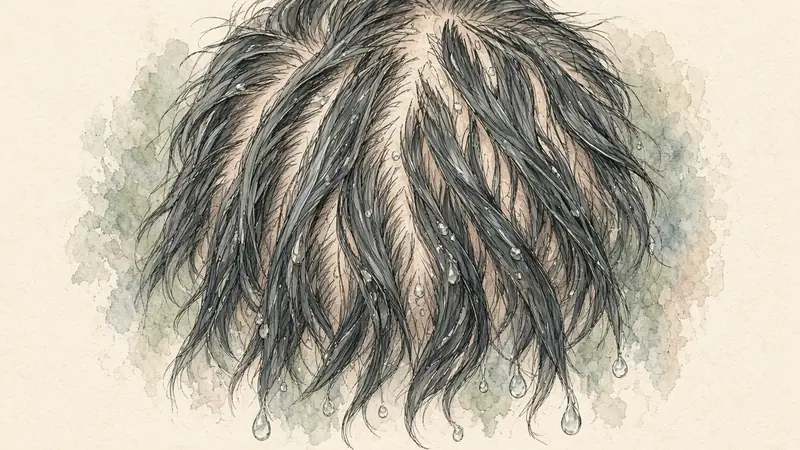
What you are seeing
Out of the shower, hair separates into dark, glossy ribbons. Between them run lines of pale scalp, sometimes along the part, often over the crown. For many people this is the first moment they think "my hair is thinning". It is also one of the least reliable views of the scalp you can get, because water changes how hair behaves far more than it changes how much hair you have.
Why wet hair shows more scalp
Dry hair fibers sit loosely, with air between them, and each one scatters light. That loft is what covers the scalp. When hair is soaked, water fills the spaces and surface tension pulls neighboring fibers together into clumps. A head of hair that covered the scalp as a soft, even layer becomes a set of separate bundles with gaps between them. The fibers also lie flat against the head instead of standing away from it, so less of their length crosses over the skin.
Water swells the hair shaft and changes its mechanical behavior. Wet hair stretches more and breaks more easily under combing, which is one reason careful handling while wet matters so much for length retention (Robbins, 2012; Gavazzoni Dias, 2015). That is a separate issue from thinning, but it explains why aggressive towel-drying and brushing on wet hair can, over time, leave the ends looking thinner too.
Long, fine and straight hair shows the effect most. Curly and coily hair also clumps when wet, and the wet length can make a crown look very different from the dry, voluminous version.
A fair way to check
- Do not judge density while hair is wet. Let it dry completely, without product and without a hair dryer on high heat.
- Part it in your usual place and take one picture from directly above in window light.
- If you want a wet record anyway, take it the same way every time: same towel routine, same minutes after the shower, same light. Compare wet with wet and dry with dry, never one against the other.
- Look for a trend over three to six months, not a difference between Tuesday and Wednesday.
When it may be more than water
| What you notice | Usually just wet hair | Worth a closer look |
|---|---|---|
| Scalp lines between wet clumps | Hair looks normal once dry | The dry part or crown also looks wider than in older dry photos |
| More hair in the drain | A few dozen hairs, similar to usual | Clearly more than usual for weeks, often two to four months after illness, birth, a new medicine or a crash diet |
| Crown shows when wet | The whorl is visible but dry hair covers it | Dry hair no longer covers it, and the hairs there look finer than at the back |
| Short pieces on the towel | A few snapped fibers after rough drying | Many short pieces with blunt ends: see broken lengths vs thinning |
Losing some hair in the shower is normal. The American Academy of Dermatology describes shedding of roughly 50 to 100 hairs a day as usual, and washing simply collects hairs that were already loose. If the amount has clearly jumped, read diffuse thinning and compare shed hair with broken hair.
When to see a professional
See a dermatologist, or a trichologist listed at trichology.com, if hair is coming out in clumps, if you see round smooth patches, or if the scalp is sore, scaly or inflamed. Those signs do not come from water.
Is it the light or the hair?
Four one-tap questions. Nothing is stored.
A reading of a picture, not a diagnosis. Your answers stay on this page and are never stored.
If wet hair is showing more scalp than it used to and you also see more hair in the drain, the timing question belongs to the Shed Clock on Hair Experts.
Questions people actually ask
Why can I see my scalp when my hair is wet but not when it is dry?
Wet fibers stick together into separate clumps and lie flat, so they cover less of the skin. Dry hair has loft and scatters light, which hides the scalp. That difference is normal and does not by itself mean hair is thinning.
How much hair loss in the shower is normal?
The American Academy of Dermatology describes losing about 50 to 100 hairs a day as typical. Washing collects hairs that were already shed, so wash days can look heavier. A clear, lasting increase is worth noting with dates.
Keep reading
Sources
- Robbins CR. Chemical and Physical Behavior of Human Hair. 5th ed. Berlin: Springer; 2012.
- Gavazzoni Dias MF. Hair cosmetics: an overview. Int J Trichology. 2015;7(1):2–15.
- American Academy of Dermatology. Do you have hair loss or hair shedding? (public information).
- Canfield D. Photographic documentation of hair growth in androgenetic alopecia. Dermatol Clin. 1996;14(4):713–721.