Home / Compare / Shed hair vs broken hair
Is it this or that?
Shed hair vs broken hair
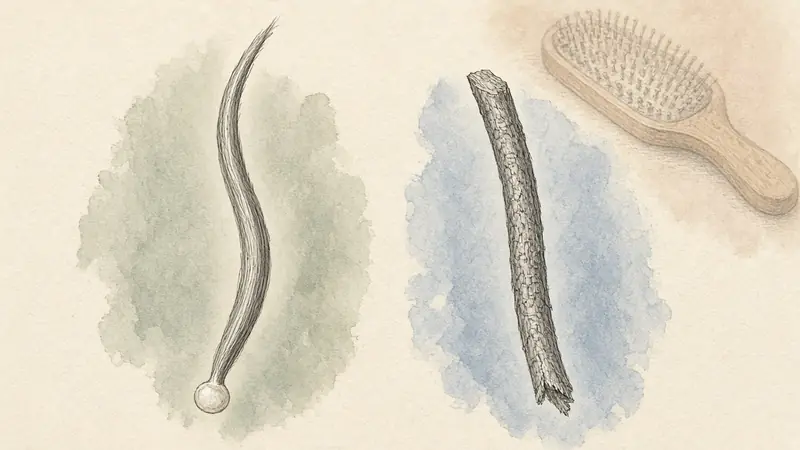
What a shed hair looks like
A shed hair has come out from the root at the end of its natural cycle. It is usually full length, or close to the length of the rest of your hair, and at the root end you can often see a small, pale, rounded bulb, sometimes called a club. That bulb is the sign of a resting (telogen) hair that has finished growing and been released. Shedding is normal: the American Academy of Dermatology describes about 50 to 100 hairs a day as typical, and wash days collect several days' worth at once.
What a broken hair looks like
A broken hair has snapped somewhere along its length. It has no bulb. It is often shorter than the hair around it, and the broken end may be blunt, frayed, split or brush-like under a magnifier. Breakage comes from weathering of the fiber: heat, bleaching and chemical straightening, rough handling when wet, tight elastics, friction and dryness all weaken the cuticle and cortex over time (Robbins, 2012; Gavazzoni Dias, 2015).
Side by side
| Feature | Shed hair | Broken hair |
|---|---|---|
| Root end | Small pale bulb (club) | No bulb; a cut, blunt or frayed end |
| Length | Usually full length | Often short pieces, a few centimetres long |
| Where you find them | Brush, shower drain, pillow, clothes | Bathroom floor, sink, around where you style, on the towel |
| What it suggests | Normal turnover, or more shedding than usual if the amount jumps | Fiber damage; scalp hair count may be unchanged |
| What helps | Finding the trigger if shedding has increased | Gentler handling, less heat and chemical stress, conditioning, trims |
How to check yours
- Collect the hairs from one brushing or one wash on a sheet of white paper (or dark paper for blonde hair).
- Sort them into two piles: long hairs with a bulb, and shorter pieces without one. A magnifier or phone zoom helps.
- Note the date and roughly how many of each. Repeat once a week for a month, under the same routine.
- If most are broken pieces, read broken lengths vs thinning and dry and porous hair. If shed hairs have clearly increased, read diffuse thinning.
A hair pull test, gently pulling a small bunch of hair to see how many come out, is something clinicians use as part of an examination (Shapiro, 2007). At home, the sort-and-count method above is gentler and gives you a record over time.
Reading the result kindly
Finding mostly broken pieces is good news in one sense: the follicles are still producing hair, and the work is in protecting the lengths. Finding more shed hairs than usual is worth taking seriously but is very often temporary, especially after a clear trigger. In both cases, a few weeks of notes will tell you far more than one alarming handful in the shower. The quiz below sorts your answers and suggests one gentle next step.
What the mix can tell you
Most people find some of each. A typical sorted pile from a healthy head might hold mostly full-length shed hairs and a few broken pieces. Lots of short pieces from the lengths, with the usual number of shed hairs, points toward handling, heat or dryness. A clear jump in shed hairs, with the usual number of broken pieces, points toward a change in the hair cycle, often after a trigger. Short hairs with tapered, pointed tips are something else again: they are often new regrowth, or finer hairs from a patterned area, and they are worth noticing rather than worrying about. Keeping the piles separate for a few weeks is what turns those impressions into a pattern you can trust.
When to see a professional
See a dermatologist, or a trichologist listed at trichology.com, if hair is coming out in clumps, if shedding stays high for more than a few months, if broken hairs appear along with scalp soreness or scale, or if you see round patches.
Roots, lengths or fiber?
Four one-tap questions to sort a fiber issue from a root issue. Nothing is stored.
A reading of a picture, not a diagnosis. Your answers stay on this page and are never stored.
Once you know you are looking at whole shed hairs, the next question is usually why now. Hair Experts explains the club hair with a white bulb and has a Shed Clock that dates a shed to its likely trigger.
Questions people actually ask
Is a white bulb on a fallen hair bad?
No. The small pale bulb is the normal root end of a resting hair that has finished its cycle. It means the hair was shed, not pulled out or broken.
How can I stop hair breaking?
Handle hair gently when wet, use a wide-tooth comb from the ends upward, reduce heat and chemical treatments, choose soft hair ties, and keep the lengths conditioned.
Keep reading
Sources
- American Academy of Dermatology. Do you have hair loss or hair shedding? (public information).
- Robbins CR. Chemical and Physical Behavior of Human Hair. 5th ed. Berlin: Springer; 2012.
- Gavazzoni Dias MF. Hair cosmetics: an overview. Int J Trichology. 2015;7(1):2–15.
- Shapiro J. Hair loss in women. N Engl J Med. 2007;357(16):1620–1630.
- Headington JT. Telogen effluvium: new concepts and review. Arch Dermatol. 1993;129(3):356–363.