Home / See / Broken lengths vs thinning at the root
Presentation
Broken lengths vs thinning at the root
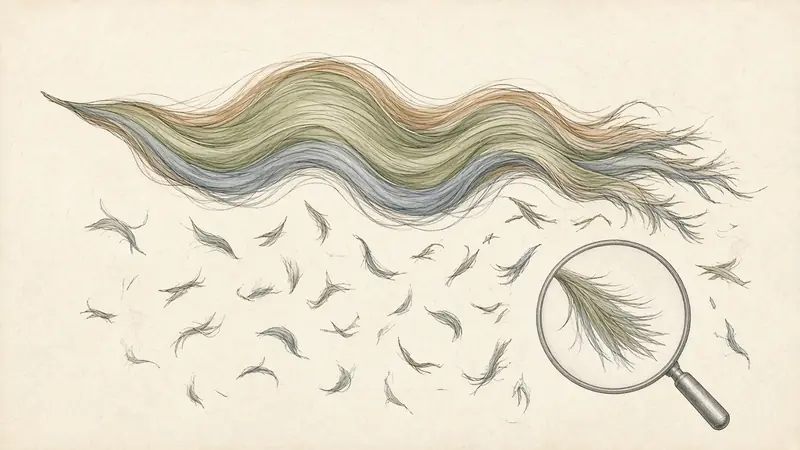
What this looks like
Short hairs at the surface of a parting can mean two very different things. They can be hairs that have grown in shorter and finer, tapered toward the end, which is the picture clinicians associate with miniaturization in a patterned change. Or they can be hairs that grew to a normal thickness and then snapped, leaving a blunt or brush-like end at a fairly consistent length, which is a fiber problem (breakage) and which can make a ponytail thinner without a single follicle having changed its mind.
Both can be present at once. A patterned scalp can also have fragile lengths. The point of this page is to stop a heap of broken hair in the brush from being automatically named “hair loss,” and to stop a field of tapered short hairs at the part from being automatically named “I need a protein treatment.”
What it can be confused with
| Lookalike | How it overlaps | A useful distinction |
|---|---|---|
| Miniaturized, tapered short hairs | Both put short hairs in the part. | Tapered, finer caliber, mixed in with thicker hairs at the same site, is the miniaturization picture. See that page as well. |
| A timed shed of whole hairs | The brush is full, and the hair looks thinner. | Shed hairs often have a pale bulb at the root end (a club hair). Broken hairs have a ragged or blunt shaft end and no bulb. |
| A recent cut or a fringe | Short hairs of even length appear by design. | You know if you cut them. If you did not, and they appear along the mid-lengths or at a part you comb hard, think of breakage. |
| New growth after a shed | Short hairs at the hairline can be welcome regrowth. | Regrowing hairs are usually tapered and grow longer over weeks. They should not be bleached or yanked out to ‘test’ them. |
How to photograph this view
You need a close, well-lit picture of the short hairs themselves, and a wider picture of the part or the mid-lengths where they live. A phone in a window, held steady, is enough; a cheap clip-on macro lens can help but is not required. Look at the ends: blunt and frayed, or finely tapered? Look at the thickness compared with the neighbouring long hairs. Look at whether the short hairs prefer a combed part, a pillow-and-hat zone, or a dyed mid-length. Do not use flash, which flattens the ends.
If you have been colouring, heat-styling, or tying the hair tightly, write that on the file. The handling and porous fiber pages are the care companions when the ends look snapped.
What the literature actually says
Hair fibers are weaker when they are wet than when they are dry, which is a materials fact recorded in standard hair-science texts, and which is why rough towel-drying and brushing soaked hair produce broken lengths. Chemical colour, bleach, and high heat raise porosity and make the same handling more costly. None of that requires a clinic to be true, and none of it proves that the roots are healthy. It only explains a blunt short hair.
At the root, a different literature describes miniaturization: a progressive reduction in diameter and in the time a hair spends growing, which is the follicular story of patterned thinning. Trichoscopy criteria for female androgenetic alopecia, such as those proposed by Rakowska and colleagues in 2009, compare the frontal scalp with the occipital scalp and look, among other signs, at the share of thin hairs. Those signs are read with a dermatoscope in clinic. They are not a bathroom diagnosis, but they are the reason this site refuses to treat every short hair as a broken one.
When to see a professional
If you cannot tell the ends apart, if the short hairs are increasing in a pattern zone, or if the scalp is shedding whole bulbs in large numbers, be examined. A dermatologist, or a trichologist at trichology.com, can look at both the fiber and the follicle. If the picture is clearly breakage, start with handling and with the fiber-care pages rather than with a product aimed at patterned thinning.
Roots, lengths or fiber?
Four one-tap questions to sort a fiber issue from a root issue. Nothing is stored.
A reading of a picture, not a diagnosis. Your answers stay on this page and are never stored.
If short hairs are appearing and you are not sure whether they are new growth or snapped lengths, Hair Experts has a side-by-side guide to regrowth versus breakage.
Questions people actually ask
My brush is full every day. Is that breakage?
Not automatically. Look at what is in the brush. Broken pieces are short segments without a root bulb. Shed hairs are usually longer and often have a pale bulb at one end. Both can be present.
Can I do a ‘tug test’ at home?
Pulling hair to see how much comes out is easy to overdo and hard to standardize. If you are worried about a shed, a clinician can examine you; do not make a test of yanking.