Home / See / A ponytail that feels smaller
Presentation
A ponytail that feels smaller
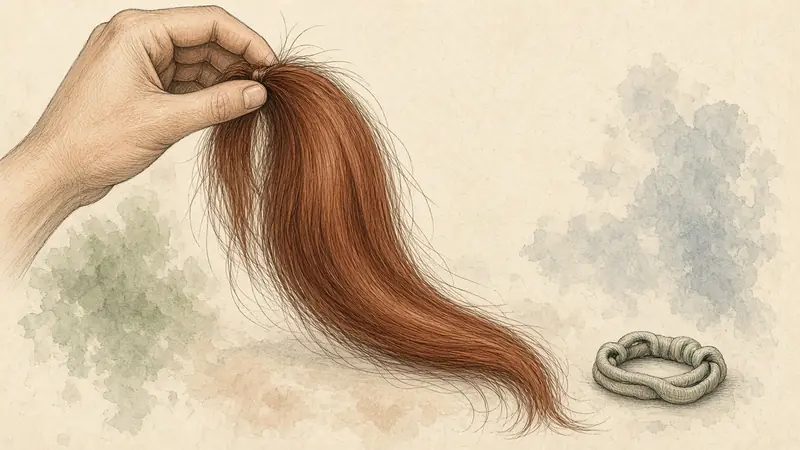
What this looks like
A thinner ponytail is a change you feel in the hand before you necessarily see it in the part. The elastic sits in a smaller circle. The tail looks less substantial in a rear photograph. People often date it to a haircut, a year, or a pregnancy, and then wonder whether they are imagining it. They may not be. They also may be mixing three different things into one sensation: how many hairs are there, how thick each hair is, and how long the hair is.
That mixing is why a ponytail is a useful personal baseline and a poor diagnostic instrument. A haircut that removes length will shrink a circumference even if not a single hair has been lost. So will a period of breakage. So will a true drop in density or in diameter. The job of this page is to treat the ponytail as a record of you, not as a number you can compare with a chart on the internet.
What it can be confused with
| Lookalike | How it overlaps | A useful distinction |
|---|---|---|
| A shorter cut or a recent trim | Less length means less bundle to measure. | Measure at a marked length, or wait until the hair is back to the previous length, before you compare. |
| Breakage of the lengths | The tail is thinner because many hairs do not reach it. | Look at the ends and at short blunt hairs along the mid-lengths. See breakage versus thinning. |
| A drop in density or in diameter | Both reduce the cross-section of the bundle. | A ponytail cannot separate them. A part photograph and, if needed, a clinician’s trichoscopy get closer. |
| The two-inch and three-inch rules | Beauty writing often calls under two inches “low density” and over three inches “high.” | We did not find a clinical study that validates those cut-offs as diagnostic thresholds. Do not use them as a verdict. |
How to photograph and measure this view
Gather the hair as you usually would, at the same height on the head, when it is clean, dry, and free of heavy product. Measure the circumference of the tail just below the elastic with a sewing tape or a marked ribbon, and write down the length of the hair at the same time. Take a photograph from behind. Repeat at the same length, or note the new length if you have had a cut. The method page on ponytail circumference sets this out as a protocol.
Pair the number with a part photograph from the same day. A shrinking tail with a stable part may be a length or breakage story. A shrinking tail with a widening part is a different picture.
What the literature actually says
Hair scientists have long pointed out that what people perceive as “amount” of hair is closer to density multiplied by diameter than to either one alone. Clinic versions of that idea include hair-mass measures that combine the two. A ponytail circumference is a crude, homemade cousin of the same thought: it is a bundle cross-section, not a count. It is also sensitive to length and to styling, which the clinic measures try to control and a bathroom measurement often does not.
Population studies of density, such as Birch, Messenger and Messenger (2001) in women, show that density can fall with age even as diameter sometimes changes in the other direction for a time. A ponytail can therefore move, or fail to move, for reasons that a single story about “losing hair” will not capture. That is an argument for a careful record, not for an internet cut-off.
When to see a professional
If the tail has changed quickly, if it is accompanied by a heavy shed, a widening part, or a scalp that does not look well, be examined. A dermatologist, or a trichologist at trichology.com, can look at the roots as well as the bundle. A thinner ponytail alone, especially after a cut, is not an emergency, but it is also not something you have to talk yourself out of. The diffuse and breakage pages will help you decide which picture you are actually holding.
Is it the light or the hair?
Four one-tap questions. Nothing is stored.
A reading of a picture, not a diagnosis. Your answers stay on this page and are never stored.
A ponytail that thinned over one season, rather than over years, is often a shed rather than a pattern. Hair Experts explains seasonal shedding and has a Shed Clock for dating a shed to the event that started it.
Questions people actually ask
Should I compare my ponytail with a friend’s?
No. Ancestry, length, curl and diameter make other people’s tails a bad control. Compare your own measurements, taken the same way.
My tail shrank after I cut six inches off. Did I lose hair?
Not necessarily. Length is one of the three ingredients in the circumference. Re-measure when the length is back, or treat the new length as a new baseline.