Home / Measure / Using a ponytail as a baseline
Measurement
Using a ponytail as a baseline
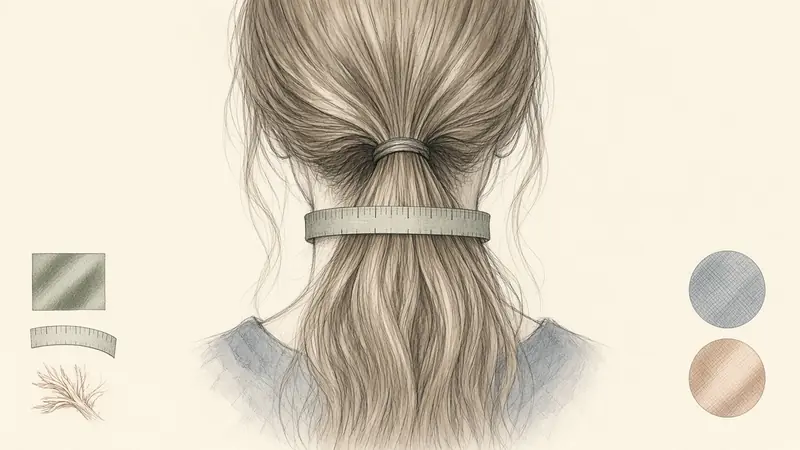
What you are measuring
A ponytail circumference is the distance around the bundle of hair at a chosen point, usually just below an elastic, when the hair is gathered as you usually gather it. It is a mixed measure. It goes up and down with how many hairs reach that point, how thick each hair is, and how long the hair is. A shorter cut will shrink it. So will a season of breakage. So will a true drop in density or in diameter. That is why the method is useful as a baseline of yourself and almost useless as a comparison with a chart.
A method you can repeat
Start with clean, dry hair and no heavy product. Gather it at the same height on the head you always use, with the same kind of elastic, at a comfortable tension that you can repeat, not a yank. Measure the circumference just below the elastic with a sewing tape, or wrap a ribbon, mark it, and measure the mark. Write down the hair’s length at the same time, from the elastic to the ends, or from a fixed point on the head if you do not wear a ponytail at the same height. Photograph the tail from behind. Repeat at the same length, or start a new baseline after a major cut, and do not compare a wet tail with a dry one.
The two-inch and three-inch rules
| Claim you may have read | What we can say about it |
|---|---|
| Under two inches is ‘low density’; over three inches is ‘high’ | These figures circulate in beauty writing. We did not find a clinical study that validates them as diagnostic thresholds, and we will not use them as one. |
| A shrinking tail means you are going bald | A shrinking tail means the bundle is smaller. The reason might be length, breakage, diameter, density, or a mix. The number cannot tell you which. |
| You can compare tails with a friend or a chart | Ancestry, curl, length and diameter make other people’s tails a bad control. |
What the literature actually says
Researchers who study “hair amount” have argued that what people perceive is closer to a combination of density and diameter than to either one alone. Clinic tools such as a hair-mass index try to capture that combination under controlled conditions. A ponytail tape-measure is a homemade, less controlled cousin: it is a bundle cross-section, not a count, and it is also sensitive to length, which the clinic tools usually hold constant. Birch, Messenger and Messenger (2001) showed, in a large group of women, that density and diameter can move differently with age. A tail can therefore change, or fail to change, for more than one reason. That is an argument for pairing the number with a part photograph, not for promoting a cut-off.
When a smaller tail should turn into an appointment
If the circumference has dropped quickly, if it is accompanied by a heavy shed or a widening part, or if the scalp does not look well, see a dermatologist or a trichologist at trichology.com. Bring the numbers and the photographs. If the drop followed a haircut, start a new baseline before you invent a disease.
Pair the number with a picture
A circumference without a part photograph is a number in the dark. A shrinking tail with a stable part and a heap of blunt short hairs in the brush is often a length or breakage story, and the handling pages will be more useful than a pattern product. A shrinking tail with a widening part and a mix of calibers at the roots is a different picture, and an examination will be more useful than a new elastic. Write the length, the circumference, and the date on the photograph itself, so that you cannot later compare a long June tail with a short October one and call the difference a disease.
Questions people actually ask
I do not wear a ponytail. Can I still do this?
Only if you can gather the hair the same way each time without hurting the edges. If you cannot, skip this method and rely on photographs of the part and the crown.
Should I measure at the roots or lower down?
Just below the elastic, at a height you can repeat, is enough. Measuring at several stations along a long tail will mix in even more breakage and length effects.