Home / Compare / Fine hair vs thinning hair
Is it this or that?
Fine hair vs thinning hair
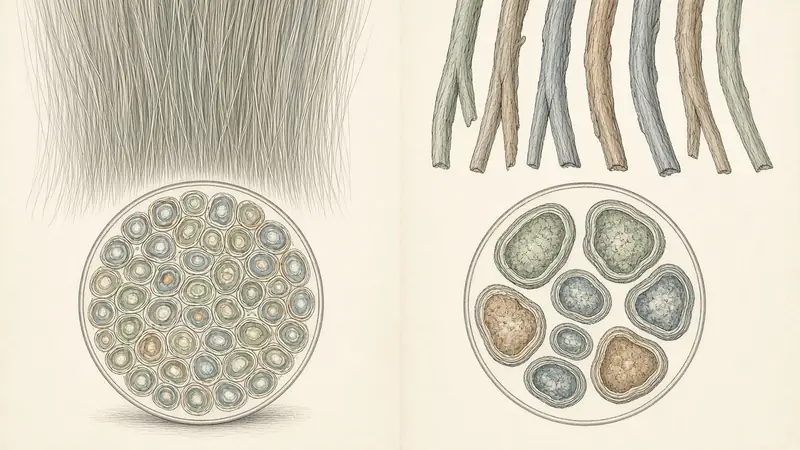
Two different measurements
"Thin hair" is used for two separate things. One is fine hair: each fiber has a small diameter. The other is thinning hair: there are fewer hairs per area than before, or the hairs are becoming finer than they used to be. Researchers measure them separately. In a study of women with and without female-pattern hair loss, Birch and colleagues measured both density and diameter and showed that the two vary independently, with density falling in pattern loss (Birch, 2001).
Fine hair is a trait. Many people, often those with fair or straight hair, have fine hair all their lives and a perfectly normal hair count. Fine fibers bend easily, carry less volume, and show the scalp more readily, especially when oily or wet. Thinning is a change. It shows up as a difference from your own earlier hair, not from someone else's.
Side by side
| Feature | Fine hair | Thinning hair |
|---|---|---|
| What it is | Small diameter per fiber, a lifelong trait | Fewer hairs, or hairs getting finer, compared with before |
| Over time | Stable in comparable photos | Part widens, crown shows more, ponytail shrinks |
| Across the head | Similar on top and at the back | Often less coverage on top than at the back |
| Hairs in one area | Similar to each other | A mix of thick and noticeably finer, shorter hairs |
| Responds to styling | Strongly: cut, products and washing change the look | Styling helps but does not reverse the trend |
How to tell which you have
- Roll a single hair from the back of your head between finger and thumb, then one from the part. If both feel equally fine, fineness is likely a trait. If hairs from the part feel noticeably finer, note it.
- Measure your ponytail circumference at the base and note the date. Repeat in three months under the same conditions. See ponytail circumference.
- Photograph your part and crown in window light and compare with older photos taken the same way.
- Compare coverage on top with the back of the head. See front vs back.
Caring for each
Fine hair looks fullest when it is clean, light and cut to suit it. Gentle shampoo, conditioner kept to the lengths, and avoiding heavy oils at the roots all help. The fine hair and fullness page covers this. Thinning hair benefits from the same gentle care, plus attention to the cause: the presentation pages, a professional's view, and, where relevant, blood work. The short quiz on this page sorts fiber questions from root questions and suggests one next step.
It also helps to keep the two ideas separate in how you talk about your hair. Saying "my hair is fine" describes a trait you can style around. Saying "my hair is thinning" describes a change you can measure and, with the right help, respond to. Mixing them up is how people end up buying volumizing products for a pattern change, or worrying about a pattern when they simply have fine hair on a humid day.
Common mix-ups
Fine hair is often judged on its worst day: wet, oily, flattened by a hat, or photographed from above under a downlight. On those days anyone with fine hair will see more scalp. Thinning hair, on the other hand, can be missed for a long time if a person has always had very dense hair, because the loss of a share of hairs still leaves good coverage. A third mix-up is breakage: lengths that have been weakened by heat or bleach look sparse at the ends, which can feel like thinning even when the roots are unchanged. Separating those three, trait, change at the root and damage to the lengths, is the purpose of the home tests above.
When to see a professional
See a dermatologist, or a trichologist listed at trichology.com, if comparable photos or measurements show a real decline, if shedding has increased, or if you notice patches, soreness or scale.
Roots, lengths or fiber?
Four one-tap questions to sort a fiber issue from a root issue. Nothing is stored.
A reading of a picture, not a diagnosis. Your answers stay on this page and are never stored.
Questions people actually ask
Can fine hair become thicker?
The diameter you are born with is largely genetic. Good care keeps the fibers you have in better condition, and cut and styling can add a great deal of visible volume.
Does fine hair mean I will lose my hair?
No. Fine hair is a trait, not a diagnosis. Many people with fine hair keep a normal hair count throughout life.
Keep reading
Sources
- Birch MP, Messenger JF, Messenger AG. Hair density, hair diameter and the prevalence of female pattern hair loss. Br J Dermatol. 2001;144(2):297–304.
- Robbins CR. Chemical and Physical Behavior of Human Hair. 5th ed. Berlin: Springer; 2012.
- Olsen EA. Female pattern hair loss. J Am Acad Dermatol. 2001;45(3 Suppl):S70–S80.
- Rakowska A, Slowinska M, Kowalska-Oledzka E, Olszewska M, Rudnicka L. Dermoscopy in female androgenic alopecia: method standardization and diagnostic criteria. Int J Trichology. 2009;1(2):123–130.