Home / See / Scalp showing through the hair
Presentation
Scalp showing through the hair
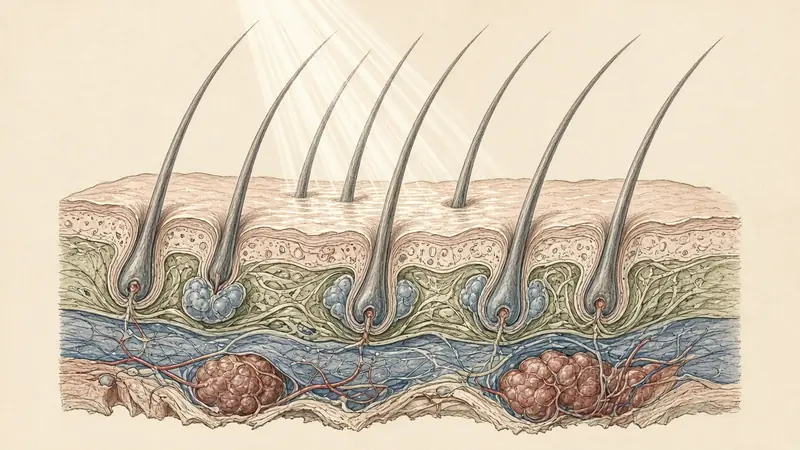
What this looks like
Visible scalp is the sensation or the photograph in which skin shows through the hair in a place you do not remember it showing: a part, a crown, a temple, or, more unsettlingly, almost everywhere in a certain light. It is not a diagnosis. It is an optical event. How much scalp you see depends on how many hairs are there, how thick they are, how they are curled or lifted, how dark they are against the skin, and what the light is doing. A fair reading has to hold all of that, or it will turn a new haircut or a new bathroom bulb into an emergency.
People with dark hair on a light scalp, or with naturally low contrast in the other direction, live with different versions of this problem. Tightly curled hair can hide or reveal the scalp depending on shrinkage and on how it is parted. Straight, fine hair lies flatter and shows more of what is underneath even when the count has not changed. None of that is a reason to ignore a real change. It is a reason to photograph carefully.
What it can be confused with
| Lookalike | How it overlaps | A useful distinction |
|---|---|---|
| A true drop in density or a widening part | Both show more scalp. | A comparable photograph, and a look at whether one zone is preferred, begins to separate an optical change from a patterned or diffuse one. |
| A change in colour or contrast | A darker dye, a fade, or a summer tan of the scalp will change show-through. | Note colour when you photograph. Compare like with like. |
| Wet hair, flash, and overhead light | All increase apparent show-through. | Re-shoot dry, without flash, in window light. See the photographs page. |
| Fine hair that has always shown some scalp | Fine strands cover less of the skin than coarse ones, even at a high count. | An older photograph of the same lighting is more useful than a feeling that ‘people should not see my scalp.’ |
How to photograph this view
Pick the one view that bothers you most (a part, the crown, the hairline) and also take a control view of the back of the head. Dry hair, no flash, a window, the same time of day. If you wear a tinted concealer or a thickening fiber on ordinary days, take the record set without it, and say so on the file name. A dark top will exaggerate every parting; a lighter top is a kinder, more repeatable background.
If the show-through is everywhere, treat it as a diffuse set. If it is a line, use the part-width method. If it appears mainly in pictures, read when photos make hair look thinner before you change anything else.
What the literature actually says
Clinic density is a count per unit area, usually at a defined site, with a defined method. Show-through in a photograph is not that count. It is closer to a perception of coverage, which is influenced by diameter as well as by density, and by contrast and by styling. Studies of “hair amount” have argued that combining density and diameter tracks what people perceive better than either alone. That is a research observation, not a home formula you can compute with a phone.
Ancestry and site matter for the underlying counts. A New York trichoscopy study in a healthy American population reported different mean densities in adults of European, Hispanic and African descent, and work from other countries has found different ranges again (Birnbaum and colleagues, 2018, is one such study). Those figures describe groups, measured in a clinic. They do not tell you how much scalp you are “allowed” to see in a selfie.
When to see a professional
If the show-through is new, spreading, or accompanied by a heavy shed or an unhappy scalp, be examined. A dermatologist, or a trichologist at trichology.com, can look past the optics. If the show-through is old and stable in comparable photographs, you may be looking at a contrast and texture fact rather than at a crisis, which is still allowed to bother you, but does not have to be treated as a rapidly advancing pattern.
Is it the light or the hair?
Four one-tap questions. Nothing is stored.
A reading of a picture, not a diagnosis. Your answers stay on this page and are never stored.
Questions people actually ask
I have always been able to see some scalp. Is that thinning?
Not on its own. Many people, especially with fine or tightly parted hair, have always had some show-through. A change from your own baseline is the signal that matters.
Do thickening fibers or concealer ruin a record?
They ruin comparability if you use them in one set and not in the next. Keep a clean record set, and use cosmetics later if you want to, separately from the record.
Keep reading
Sources
- Birnbaum MR, McLellan BN, Shapiro J, Ye K, Reid SD. Evaluation of hair density in different ethnicities in a healthy American population using quantitative trichoscopic analysis. Skin Appendage Disord. 2018.
- Birch MP, Messenger JF, Messenger AG. Hair density, hair diameter and the prevalence of female pattern hair loss. Br J Dermatol. 2001;144(2):297–304.
- American Academy of Dermatology. Hair loss resource center (public information).