Home / Measure / What home density checks can do
Measurement
What home density checks can do
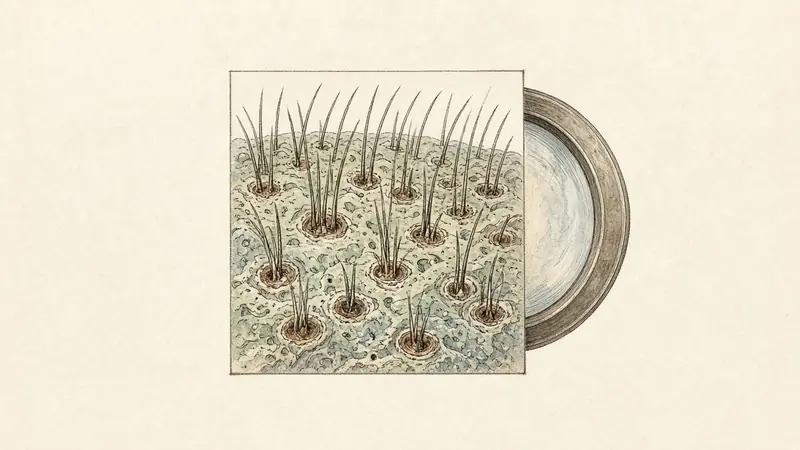
What density is
Hair density, in a clinic or a paper, is a count of hairs (or of follicular units) per unit area of scalp, usually per square centimetre, at a named site, with a named method. The method matters. A biopsy counts follicles, including very small ones, in a plug of skin. A phototrichogram counts shaved hairs in a marked window, sometimes twice, a few days apart, to separate growing hairs from resting ones. Trichoscopy counts what a magnified camera can see in a small field. Those numbers are not interchangeable, and none of them is the same thing as “I can see my scalp today.”
What a home check can do
At home you can look at scalp show-through, at a part width, at a ponytail circumference, and at comparable photographs. You can, if you like, try to count hairs in a photographed square, and some app-based tools offer to do that for you. All of these are rough. They mix density with diameter, with colour contrast, with curl, with lighting, and with how you parted the hair. They are useful only as a trend in you, under the same conditions, and they are not a way to compare yourself with a published mean.
| Home check | What it roughly tracks | What it cannot do |
|---|---|---|
| Scalp show-through in a photograph | Coverage, which is density plus diameter plus contrast plus light. | Produce a hairs-per-square-centimetre figure, or a diagnosis. |
| Part width | The appearance of one line. | Stand in for a count at that site, or for a Ludwig grade. |
| Ponytail circumference | A bundle cross-section, also sensitive to length. | Separate density from diameter, or validate a two-inch cut-off. |
| A phone ‘count’ in a cropped square | Whatever the camera and the software can see that day. | Match a clinic method, or be compared with a paper’s mean. |
What the literature actually says
Published densities vary with ancestry, with the site on the scalp, with age, and with the method. A New York trichoscopy study in a healthy American population reported different mean densities in adults of European, Hispanic and African descent (Birnbaum and colleagues, 2018). In 377 women in the United Kingdom, Birch, Messenger and Messenger (2001) reported a mean density of 293 hairs per square centimetre at age 35 and 211 at age 70, and they noted that many women with female pattern hair loss still sat inside the broad normal range, toward its lower half. Those are group findings from defined methods. They are not a target for a bathroom count, and they are not a reason to tell yourself that a widening part “cannot be a pattern” because you assume your density is normal.
Temple density is often lower than vertex or occipital density in the same person, which is one more reason to compare the same site over time, and to compare the top with the back, rather than to hunt for a single number.
When a curiosity should become an appointment
If you are trying to count hairs at home because you are worried, the appointment is already justified. A dermatologist, or a trichologist at trichology.com, can use a method that actually counts. Bring your photographs. Leave the published means in the papers they came from.
A note on apps and devices
Phone apps and consumer scopes will sometimes offer a density number, a percentage, or a stage. Those outputs can be interesting, and the close pictures can be useful to a clinician. They are not interchangeable with Birnbaum’s trichoscopy means or with Birch’s photographic counts, and they are not interchangeable with each other after a software update. If you use one, use the same device, the same site on the scalp, and the same lighting, and treat the number as a rough personal index, not as a finding you have to live up to. When the app and the photograph disagree, believe the photograph you can still see, and believe a clinician more than either.
Questions people actually ask
Is there one normal density?
No. Means differ by ancestry, site, age and method. Anyone quoting a single normal number without a source and a method is guessing.
Should I buy a home trichoscope?
You can take close pictures, and a clinician may find them useful. Do not treat a consumer device as a substitute for a standardized clinic count, and do not mix its numbers with a paper’s.
Keep reading
Sources
- Birnbaum MR, McLellan BN, Shapiro J, Ye K, Reid SD. Evaluation of hair density in different ethnicities in a healthy American population using quantitative trichoscopic analysis. Skin Appendage Disord. 2018.
- Birch MP, Messenger JF, Messenger AG. Hair density, hair diameter and the prevalence of female pattern hair loss. Br J Dermatol. 2001;144(2):297–304.
- Rakowska A, Slowinska M, Kowalska-Oledzka E, Olszewska M, Rudnicka L. Dermoscopy in female androgenic alopecia: method standardization and diagnostic criteria. Int J Trichology. 2009;1(2):123–130.