Home / See / Temples moving back
Presentation
Temples moving back
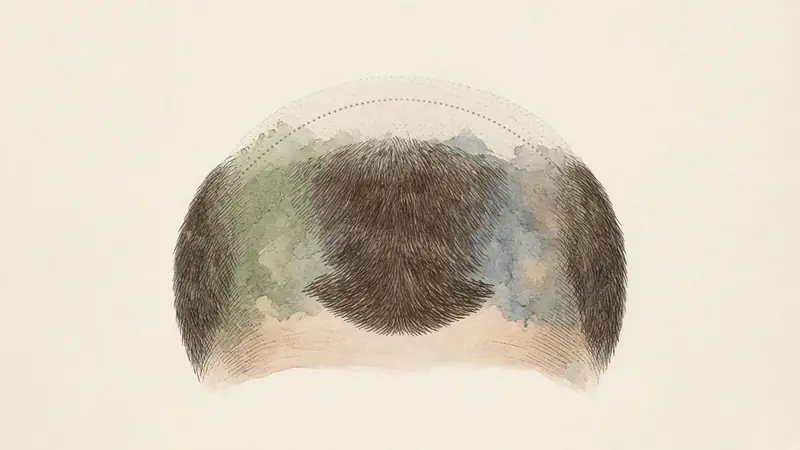
What this looks like
Temple recession is a moving back of the hairline at the two front corners, often in a roughly triangular shape, so that the hairline begins to read as an M or a widowed peak rather than as a shallow curve. It can be symmetric or a little uneven. It is one of the earliest patterned changes many men notice, and it also occurs in some women, who are then sometimes told they have a “male pattern,” which is a description of the picture, not a comment on their identity.
A mature hairline is not the same thing as recession that is still travelling. Many adults lose a little of the juvenile hairline at the temples in late adolescence or early adulthood and then stay there. The honest question is whether the corners are still moving, and whether the change is accompanied by thinning behind the hairline or at the crown.
What it can be confused with
| Lookalike | How it overlaps | A useful distinction |
|---|---|---|
| A mature hairline | Both move the temples a little from a childhood hairline. | A mature hairline is usually modest and then stable. Ongoing triangular recession, especially with miniaturized hairs at the edge, is a different picture. |
| Norwood type II or III | Norwood defined type II as triangular frontotemporal recession and type III as the minimum he considered baldness, with deeper temples. | The scale is a clinician’s language. You can photograph the corners; you do not have to name a type. |
| Traction at the front corners | Tight styles, braids, and some headwear pull at exactly these points. | A history of tension, and thinning that follows the pulled hair rather than a classic triangle, points to traction. See the edges page. |
| A changing hairline after a shed | A diffuse shed can make the temples look more open because the hair behind them is thinner. | The temples have not necessarily moved; the density behind them has. Compare an older photograph of the hairline itself. |
How to photograph this view
Stand facing a window. Take a full-face photograph, then two three-quarter views, one for each temple, with the hair pulled or combed the same way each time. Do not lift the hair off the forehead for a “revealing” shot unless you will always do that; a pulled-back view is useful as a second, clearly labelled picture, not as a replacement for the way you actually wear the hair. Include the eyebrows in the frame so that the distance from brow to hairline can be compared later. Dry hair, no flash, same camera distance.
If the crown is also a concern, photograph it on the same day. Temple and vertex change do not always keep the same pace, which is why Norwood needed a type III vertex in the first place.
What the literature actually says
Hamilton in 1951 and Norwood in 1975 mapped male pattern hair loss as a progression that often begins with frontotemporal recession. Norwood’s type II is triangular, usually symmetrical recession at those corners; type III is deeper and was, in his wording, the minimal extent sufficient to be considered baldness. Those are historical and clinical definitions, not a verdict on anyone’s appearance, and later authors have pointed out that the scale is detailed, sometimes cumbersome, and not a perfect fit for every head.
Women can present with a similar frontotemporal picture. Classification reviews treat this as a recognized variant of female pattern hair loss rather than as a curiosity. A preserved mid-frontal fringe with temple change, or a more even movement of the whole front edge, may need the changing hairline page as well.
When to see a professional
Rapid recession, a lopsided change, a sore or scaly hairline, or thinning that seems to follow a tight style all deserve an examination. So does any hairline change you want named rather than watched. A dermatologist, or a trichologist at trichology.com, is the right kind of appointment. Pattern support is written for after that picture has been taken seriously, and it will not tell you to replace a prescribed medicine with a supplement.
Which kind of support fits you?
For a gradual change at the part, crown or temples. Four one-tap questions. Nothing is stored.
A reading of a picture, not a diagnosis. Your answers stay on this page and are never stored.
Questions people actually ask
My two temples do not match. Is that unusual?
Mild asymmetry is common. A marked or rapidly worsening difference, or a difference accompanied by redness or scale, is a reason to be examined rather than to average the two sides in your mind.
Can women have this picture without a mid-line widening part?
Yes. Some women present with frontotemporal recession as the main view. It is a known variant, not a rule-breaking exception.
Keep reading
Sources
- Norwood OT. Male pattern baldness: classification and incidence. South Med J. 1975;68(11):1359–1365.
- Hamilton JB. Patterned loss of hair in man: types and incidence. Ann N Y Acad Sci. 1951;53(3):708–728.
- Gupta M, Mysore V. Classifications of patterned hair loss: a review. J Cutan Aesthet Surg. 2016;9(1):3–12.
- Olsen EA. Female pattern hair loss. J Am Acad Dermatol. 2001;45(3 Suppl):S70–S80.