Home / See / Thinning in blonde and grey hair
Visual long tail
Thinning in blonde and grey hair
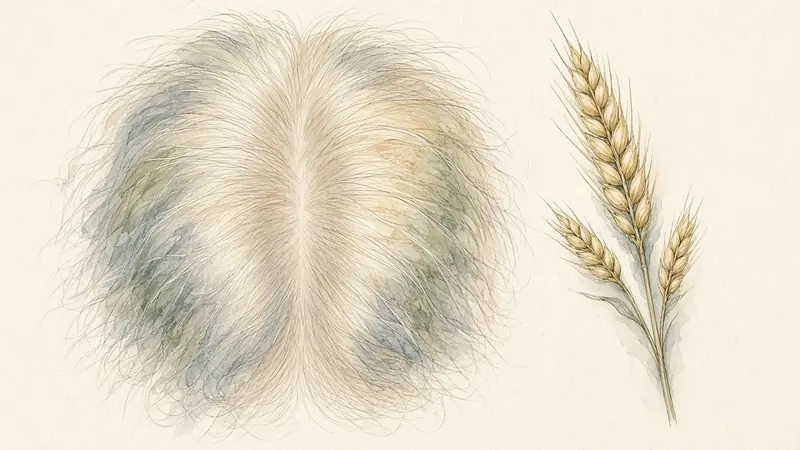
What you are seeing
Blonde, light grey and white hair play the opposite trick to dark hair. Because the fibers are close in tone to fair skin, the scalp does not stand out, and a part can look soft and blurred rather than sharp. That can hide a real change for a long time. Then a flash photograph, a sunny day, or a new darker hair color suddenly makes the scalp look obvious, and it feels as if the thinning happened overnight.
Why color changes what you see
What you perceive as "seeing scalp" is mostly contrast: the difference in brightness between hair and skin. Dark hair over light skin gives high contrast, so even a small gap shows. Pale hair over pale skin gives low contrast, so the same gap blends in. Light hair is also more translucent and reflective, so in bright light it can almost vanish against the skin beneath it.
That is why changes in color matter as much as changes in hair. Going darker with dye can make an unchanged part look wider, simply by raising contrast. Going lighter, or greying, can make a slowly widening part look stable. Flash photography is particularly unkind to pale hair, because it flattens the fibers into a bright haze that merges with the scalp (Canfield, 1996).
Many people with naturally fair hair also have finer fibers. Diameter and density are separate measurements, and fine hair can look thin even when the count is normal, as the fine vs thinning page explains (Birch, 2001).
How to check pale hair fairly
- Use soft, indirect window light rather than flash or a ring light, and keep the same light every time.
- Photograph against a mid-toned background, and keep the camera at a fixed distance above the head.
- If you change your hair color, take a new baseline right after the change, and only compare photos taken in the same color.
- Look at the width of the part and the crown over months, not at how "bright" the scalp seems on a given day.
When it may be a real change
| What you notice | Often contrast or light | Worth a closer look |
|---|---|---|
| Scalp suddenly obvious after dyeing darker | Same part width as before in old photos | Part is wider than in photos taken in the same color |
| Part looks bright in flash photos | Fine in window light | Also wider in window light, broadest at the front |
| Hair feels thinner in a ponytail | Fine fibers, unchanged circumference | Ponytail circumference has dropped over months: see the ponytail page |
| More hairs on pillows and clothes | Pale hairs are simply harder to notice day to day | A clear increase that started two to four months after an event |
If the window-lit picture shows a widening part over time, read the widening part page. If the change is even across the head, read diffuse thinning. The short quiz on this page will help you decide which.
Keeping a record you can trust
Because light hair hides change, a written record helps as much as photographs. Note the date, your hair color, the light you used, and two simple measurements: the width of your usual part at the front, measured against a ruler in the photo, and your ponytail circumference at the base. Repeat them every three months in the same way. If both stay steady, the bright scalp you noticed in one photograph was contrast. If both move in the same direction over two or three visits, you have a real, gentle trend worth reading about and, if you want, discussing with a professional. Either answer is more useful than a single worrying picture.
When to see a professional
See a dermatologist, or a trichologist listed at trichology.com, for round patches, scalp soreness or scale, or if loss is fast. Light hair can hide those signs a little longer, so it helps to look closely in good light when something feels different.
Is it the light or the hair?
Four one-tap questions. Nothing is stored.
A reading of a picture, not a diagnosis. Your answers stay on this page and are never stored.
Questions people actually ask
Why does my scalp show more since I dyed my hair darker?
Darker hair over fair skin raises contrast, so the same gaps become easier to see. Compare part width with photos taken after the color change rather than before it.
Does blonde hair thin more easily?
Not necessarily. Fair hair is often finer, which can look thinner, but diameter and density are different measurements. Your own photographs over time are the useful comparison.
Keep reading
Sources
- Canfield D. Photographic documentation of hair growth in androgenetic alopecia. Dermatol Clin. 1996;14(4):713–721.
- Birch MP, Messenger JF, Messenger AG. Hair density, hair diameter and the prevalence of female pattern hair loss. Br J Dermatol. 2001;144(2):297–304.
- Robbins CR. Chemical and Physical Behavior of Human Hair. 5th ed. Berlin: Springer; 2012.
- Olsen EA. The midline part: an important physical clue to the clinical diagnosis of androgenetic alopecia in women. J Am Acad Dermatol. 1999;40(1):106–109.